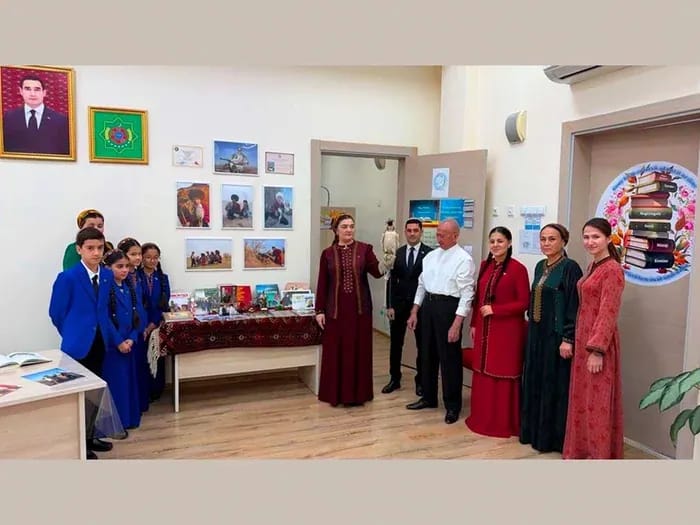
An open lesson dedicated to World Falconry Day, observed on 16 November, was held at Specialised School No. 21 in Ashgabat.
In 2010, UNESCO included the tradition of falconry in the Representative List of the Intangible Cultural Heritage of Humanity. The event marking this historic occasion was organised jointly by the school and the Bazar Amanov State Children's Library.
The meeting was attended by Atadurdy Eýberdiýew, Chairman of the National Society of Falconers of Turkmenistan and a member of the International Association for Falconry. He spoke to the pupils about the ancient falconry traditions of the Turkmen people, the distinctive features of this art and the daily activities of falconers. The experienced falconer also brought along a hunting bird.
Atadurdy Eýberdiýew said that he had been devoted to this craft since his school years and had spent approximately 40 years practising it. According to him, falconry requires considerable patience and physical endurance. There are occasions when a falconer has to put on a heavy glove, take his faithful Tazy hound along and travel dozens of kilometres across the white sand dunes.
In addition to listening to the expert's stories, the pupils had the opportunity to observe the hunting bird at close quarters and even hold it in their hands. During the event, a themed book exhibition prepared by Leyla Annamyradowa, a librarian at the State Children's Library, was also presented. Photographs published in books and magazines provided the pupils with further information about the art of falconry.
The open lesson also highlighted that Turkmen falconers most often choose saker falcons. These birds differ from other local falcon species in their larger size and hunting abilities. They can reach speeds of up to 300 kilometres per hour in flight. Their keen eyesight enables them to spot prey from a distance of two to three kilometres.
The experienced falconer also paid particular attention to the rules for raising and training hunting birds. He explained that, in order to avoid harming bird populations and disturbing the natural balance, only one chick should be taken from a nest, and only after it has reached at least three weeks of age. Experienced falconers often prefer female birds because they are generally larger and stronger. A hunting bird's characteristics can also be identified by its hooked beak and the black stripes on its tongue. Under the society's rules, a falconer may keep no more than two hunting birds.
The meeting gave pupils an opportunity to learn about the history and distinctive features of falconry traditions, as well as the importance of preserving and passing them on to future generations.




Comments
No comments yet. Be the first.