
















The Origin of the Name Farap
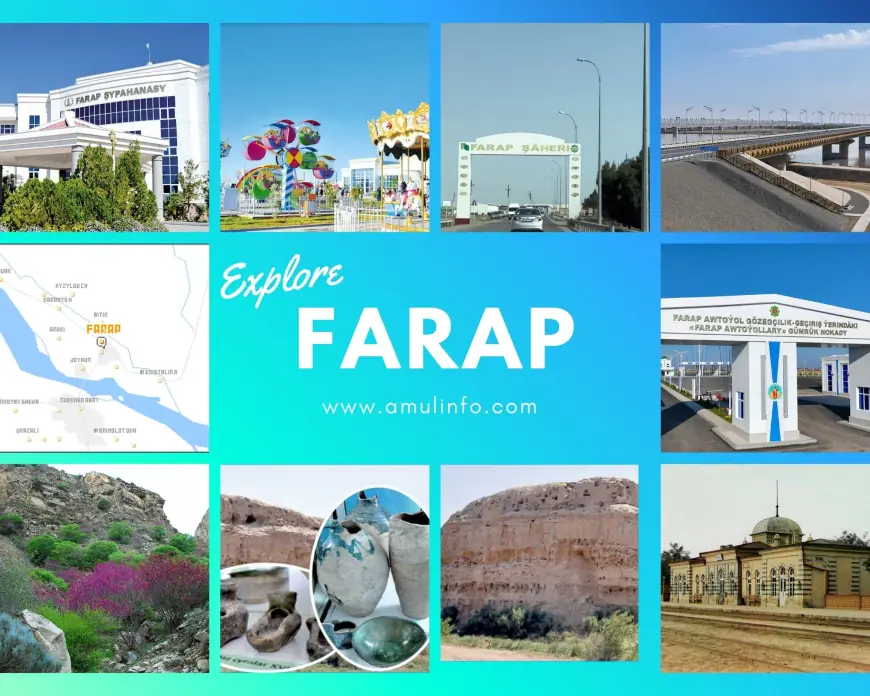
When tracing the historical roots of the Farap region, located in the eastern part of Lebap Province, it becomes clear that its name and land have, over the course of millennia, spread across various cultures and peoples. Here, the Amu Darya River and its branches have always served as a source of life for the inhabitants of the region, which highlights the special place Farap holds in human history. Today, Farap is not only a large administrative district, but throughout thousands of years it has also been a center of caravan routes, ancient cultural sites, agriculture, and water-based civilization.
There are several scholarly interpretations regarding the origin of the name Farap. Many historical sources indicate that the name comes from the Persian words “far” — shore, edge, and “âb” — water. This meaning corresponds perfectly to the region’s geography, as modern-day Farap was once located on the bank of a branch of the Amu Darya. Therefore, the word “Farap” conveys the meaning “a place by the water, a settlement on the riverbank.” In addition, in Turkic languages, the forms “barap / parap” also carried the meanings “a passage, a stopping point along the road, a campsite.” The fact that Farap was located along the Great Silk Road and served as a stopping and resting point for caravans further confirms this interpretation.
The historical path of the Farap region contains rich aspects that deserve separate study. At different times, Oghuz-Turkmen tribes lived in this area. The crops grown with the help of the Amu Darya’s water, gardening, and the everyday customs of the local population show that Farap was one of the centers of ancient culture. Due to its favorable living conditions, this land became not only an agricultural hub, but also an important point for trade activities. Caravans traveling along the Khorezm – Mawarannahr – Khorasan route stopped and rested in Farap, which contributed to the development of trade, crafts, and culture. The fact that the name Farap has appeared in various forms — Farav, Parap, Faraw — since ancient times shows that Khorezmian, Arab, and Turkic cultural layers have overlapped in this region. This place is not only a geographical name, but also clear evidence that hundreds of layers of history have accumulated here.
Farap — a land beginning at the water’s edge, a life built along the road, a passageway for peoples, and a cultural crossroads that has lived on since ancient times as an important point along the Great Silk Road.