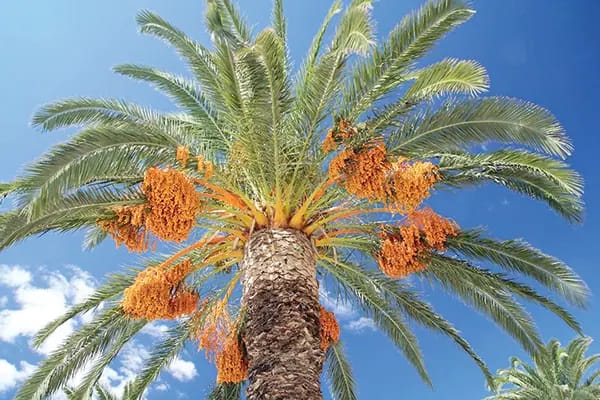
The date palm, belonging to the palm family, is primarily grown in arid regions. This slow-growing but long-lived tree reaches a height of up to 30 meters. The date palm, which has a thorny trunk and long, thin gray leaves, is dioecious. This tall tree, which has been cultivated in North Africa and the Middle East for over 6,000 years, can live for more than a century.
The date palm, belonging to the "arecaceae" family of palms, is cultivated in Portugal, Spain, along the Mediterranean coasts, and in Southern California. The date palm starts to yield a harvest within 4–8 years after planting. During the harvest season, 70–140 kilograms of dates can be obtained from each tree. Because birds and other insects eat the small dates, the branches of the date palm are covered with long bags before they ripen.
Adapted to tropical and subtropical climates, the date palm is known for its fruit that resembles the jujube (igda). This fruit, called the date, is offered to the public after being harvested and dried. The color of the fruit is yellowish-red or dark brown. Dates contain 63–64% sugar, vitamins A, E, K, and B, carbohydrates, potassium, magnesium, iron, and fiber. This highly nutritious fruit means "to carry" in Latin and "finger" in Greek.
Dates are usually exported in pitted or unpitted forms. As one of the most consumed sweet treats during the month of Ramadan (Oraza), small dates are also sold coated in honey or chocolate. Ground date seeds are used in cosmetics and dermatology. Additionally, in some countries, they are used as a coffee additive. The date is considered a symbol of agriculture in the cultures of many peoples.


Comments
No comments yet. Be the first.