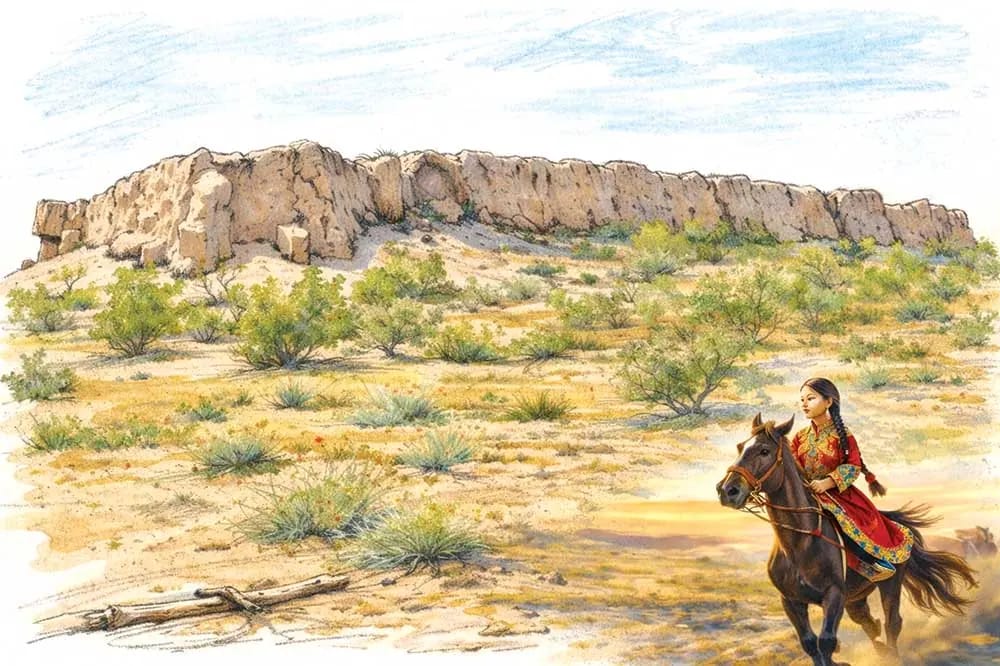
Along the banks of the Jeýhun River, many ancient monuments and fortresses bear witness to our glorious past. One of them is the archaeological site — Nargyz fortress, located in the Hojakeneps village of Farap district.
It was built in the 9th–10th centuries as a palace and developed until the mid-19th century. The fortress was mainly built from unbaked bricks, with the upper parts reinforced with wooden beams. Archaeologist G. Gutlyyev conducted scientific research at this monument and noted that the fortress was constructed in the early Middle Ages and restored several times until the end of the Middle Ages. The walls reflect the unique techniques of medieval construction.
There are several folk legends about the origin of the fortress. One of them tells:
In ancient times, the ruler of one country fell in love with the daughter of the neighboring ruler. But he could not have her. Sitting on the riverbank, the ruler said, “If you do not give your daughter, this will be my castle” and built a barrier on the river. The population downstream suffered from lack of water. The ruler declared: “Whoever opens the dam will receive half of my wealth.” Many brave young men tried, but none succeeded.
One day, the daughter of a poor man, suffering from the drought, went to the ruler and said:
— I will try this task.
The ruler was surprised:
— How will you succeed where the brave men failed?
The girl assured that with help she could succeed. She was provided with everything she needed. She requested horses with saddles to reach the blocked river. Along the way, she left a horse at each interval. Reaching the river, she cleverly opened the dam and returned home using the horses one by one, escaping the enemy army. Thus, she brought water to her country.
The ruler wanted to give the promised wealth, but the girl refused. Then he said:
— If you do not take the wealth, I will build a palace for you. Let this palace be yours.
Since then, the fortress has survived as the palace of the brave girl.
Today, the ancient fortress is protected by the state. Excavations help to study the secrets of the past. Scientific research will continue in the future.



Comments
No comments yet. Be the first.