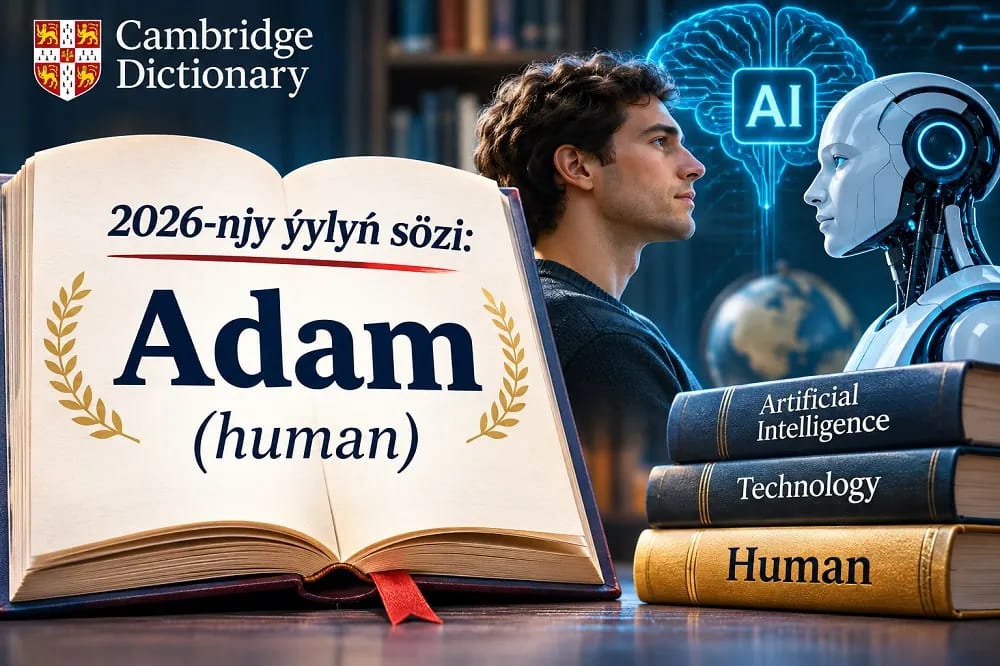
Cambridge Dictionary has selected the English word ‘human’ as its Word of the Year for 2026. The choice reflects the increasingly widespread integration of artificial intelligence into everyday life and renewed discussions about what it means to be human amid rapid technological development.
According to the dictionary's editors, the expanding capabilities of artificial intelligence are influencing perceptions of the differences between humans and machines. As technology becomes more deeply embedded in daily life and people's reliance on it grows, questions are emerging about how the role of human beings in society may change.
Colin McIntosh, a lexicographer at Cambridge Dictionary, believes that concerns about people potentially losing some of their abilities by entrusting certain thinking tasks to technology highlight the need to reassess the use of artificial intelligence. This situation also encourages deeper reflection on the place of technology in human life and the importance of the human mind.
Francesca Woodward, a member of the management board of Cambridge University Press, also noted that, in an era of rapidly advancing artificial intelligence, the word ‘human’ has become one of the key concepts capturing the spirit of the times. According to her, amid concerns that the development of AI could even threaten humanity's future, people are paying greater attention to the fundamental meaning of being human.
Cambridge Dictionary specialists also point to the growing use of the word ‘human’ in combination with other words in English. For example, ‘human-written’ means written by a person, ‘human-generated’ means created by a person, while ‘human-made’ refers to something made or produced by people.
These expressions are used to emphasise that a particular piece of work or product has been created with human involvement rather than by artificial intelligence. Thus, the selection of ‘human’ as the Word of the Year for 2026 highlights the importance of human intelligence, creativity and uniqueness in an age of advancing artificial intelligence.








Comments
No comments yet. Be the first.