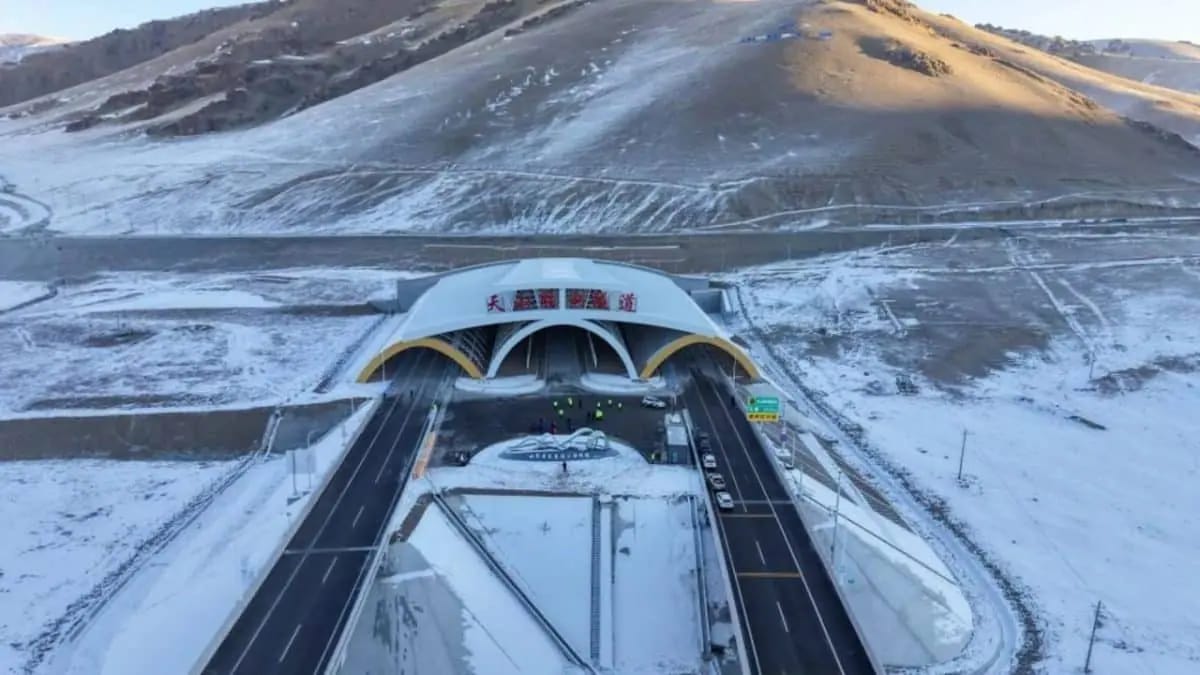
China has officially opened the Tianshan Shengli Tunnel, the central section of the Urumqi–Yuli expressway and the longest highway tunnel in the world. The tunnel stretches 22 kilometers. Built over five years using innovative engineering solutions, it has nearly halved travel time between the regional capital Urumqi and the city of Korla, reducing it to three and a half hours. The tunnel passes through the Tianshan mountain range at an altitude of about 3,000 meters above sea level, where temperatures can drop to extreme lows of –42°C.
According to the chief engineer of Xinjiang Transport Investment and Development, using traditional construction methods would have required at least ten years to complete such a highway.
As a result, engineers adopted an innovative “three tunnels and four shafts” approach. Instead of constructing a single long and deep main tunnel, three tunnels were built simultaneously — one main tunnel and two parallel ones.
The parallel tunnels allowed advance geological exploration during construction and provided access for workers and machinery. In emergency situations, the third tunnel could be used to house ventilation equipment and serve as an evacuation route.
The four shafts are vertical passages extending from the surface down to the tunnel depth, reaching nearly 700 meters. They functioned as additional access points, enabling construction work to proceed simultaneously at multiple sections. In addition to being the world’s longest highway tunnel, the project also set a world record for the deepest vertical shaft built for an automobile tunnel.
The reduced travel time between the northern and southern parts of the region will facilitate the transportation of energy resources and industrial goods northward, and agricultural products southward, contributing to overall regional economic development.





Comments
No comments yet. Be the first.