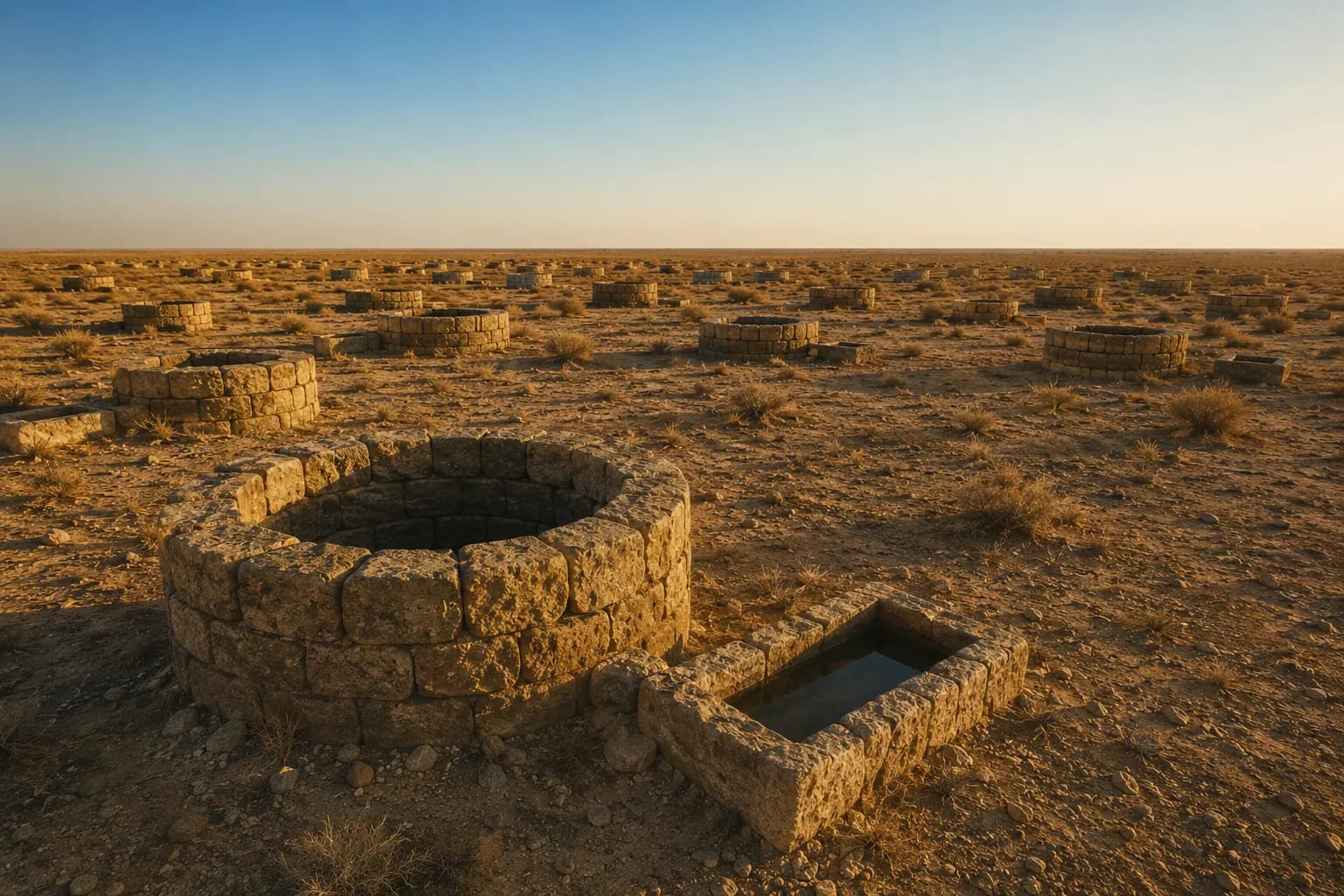
One of Central Asia’s most remarkable hydraulic engineering monuments, the Döwletli-Çok complex, is located in the arid uplands north of the Garabogaz Gulf in northwestern Turkmenistan. In the middle of the vast desert, hundreds of ancient stone-lined wells and adjacent stone watering facilities testify to the site's importance in ancient times.
According to researchers, some areas contain as many as 50–60 wells within a relatively small space. The extraordinary concentration of wells gave rise to the popular name “Döwletli-Çok,” meaning “Wealthy Place” or “Kingdom of Wells.”
At first glance, the presence of so many wells in one location may seem unusual. However, it was a sophisticated engineering solution developed by ancient builders. In the Karakum Desert, fresh groundwater typically forms a thin layer above saline aquifers. Digging a deep and wide well would allow the fresh water to mix with the salty water, making it unsuitable for drinking. To avoid this, ancient herders and caravan route builders excavated numerous shallow wells, collecting fresh water only from the upper part of the groundwater layer.
Each well within the complex is regarded as an outstanding example of traditional architecture. The walls were constructed from local limestone and flat stone slabs without the use of mortar. Thanks to the precise placement of the stones and the natural pressure of the surrounding soil, these structures have survived for centuries.
Historical sources indicate that during ancient times and the Middle Ages, Döwletli-Çok served as an important transit point. One branch of the Great Silk Road connecting the Caspian Sea coast, Khorezm, and the Mangyshlak steppes passed directly through this area. The site enabled caravans consisting of thousands of camels and horses, as well as large herds of livestock, to replenish their water supplies.
Today, Döwletli-Çok is not only a silent witness to ancient history but also a unique monument demonstrating an advanced culture of sustainable water management. In the harsh desert, where water was as precious as gold, ancient engineers succeeded in creating an independent water supply system that was well ahead of its time and perfectly adapted to the natural environment.






Comments
No comments yet. Be the first.