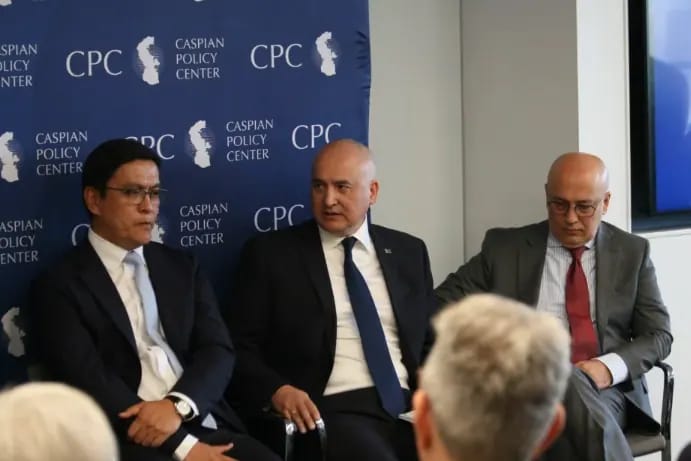
The Caspian Policy Center (CPC) in Washington held a meeting dedicated to the outcomes of the C6 Summit held in Cholpon-Ata (Kyrgyzstan) and the future prospects of cooperation between Central Asian countries and Azerbaijan. The event was attended by ambassadors from five regional states accredited to the United States, including the Ambassador of Turkmenistan, Esen Aydogdyev.
Opening the event, CPC President and CEO Efgan Nifti noted the region's transition from an era of border disputes and political tension to a period of dialogue and cooperation. He highlighted Central Asia's growing role on the economic agenda, with Azerbaijan serving as a connecting link to Caucasian and European markets. Event moderator Eric Rudenshiold, Senior Fellow at the CPC, characterized the Cholpon-Ata summit as a new milestone in relations between the five Central Asian nations and Azerbaijan, noting the increasing consistency and structure of regional political dialogue.
In his address, Turkmen Ambassador Esen Aydogdyev emphasized the rising importance of the Caspian Sea as an interregional connectivity factor. According to him, the Caspian is no longer a line of division, but rather a vital link connecting Central Asia with Azerbaijan.
Discussing future prospects for regional interaction, Aydogdyev prioritized achieving practical results, particularly the simplification of customs procedures. He noted that strengthening regional unity is one of Turkmenistan's primary objectives. The Ambassador paid special attention to Turkmenistan's policy of permanent neutrality, describing it as the core philosophy of the nation's foreign policy. He stressed that neutrality should not be interpreted as isolationism; on the contrary, it reinforces Turkmenistan's status as a reliable, predictable partner open to mutually beneficial cooperation.
Ambassadors from other nations also shared their perspectives. Azerbaijani Ambassador Khazar Ibrahim stated that the summit outcomes demonstrate regional unity, with Azerbaijan’s participation expanding the geography and practical value of the C6 format. He noted that the Middle Corridor is functioning as an active transport route rather than just a prospective project. Kazakh Ambassador Magzhan Ilyassov emphasized developing economic ties and creating conditions for sustainable dialogue. Kyrgyz Ambassador Edil Baisalov highlighted the growing capacity of regional states to resolve internal matters independently, pointing to transport developments like the China–Kyrgyzstan–Uzbekistan railway. Uzbek Ambassador Furkat Sidikov noted that joint ventures between Uzbekistan and Central Asian nations grew from around 300 in 2017 to nearly 1,500 today, expressing strong interest in digitizing the Middle Corridor.
Participants concluded that the region is steadily advancing toward practical, result-oriented cooperation in transport, energy, customs regulation, digital connectivity, investments, water resources, ecology, and tourism.


Comments
No comments yet. Be the first.