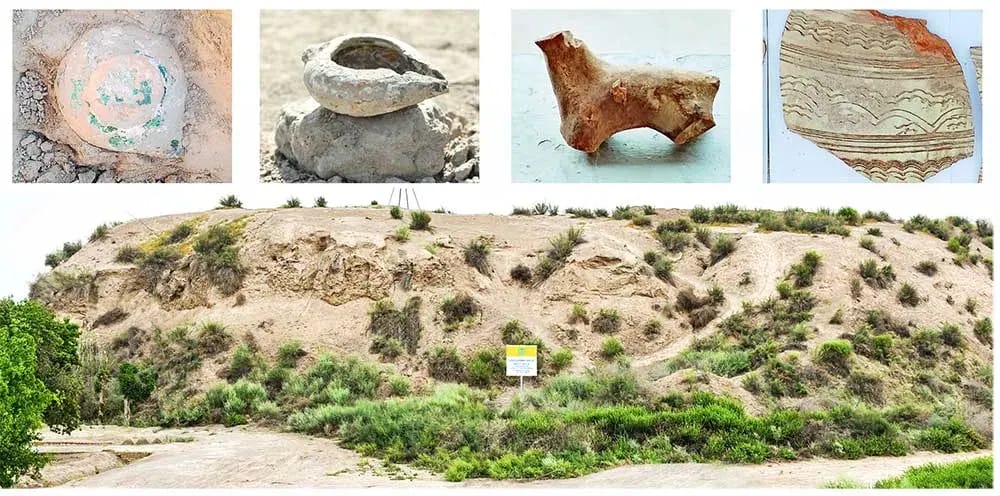
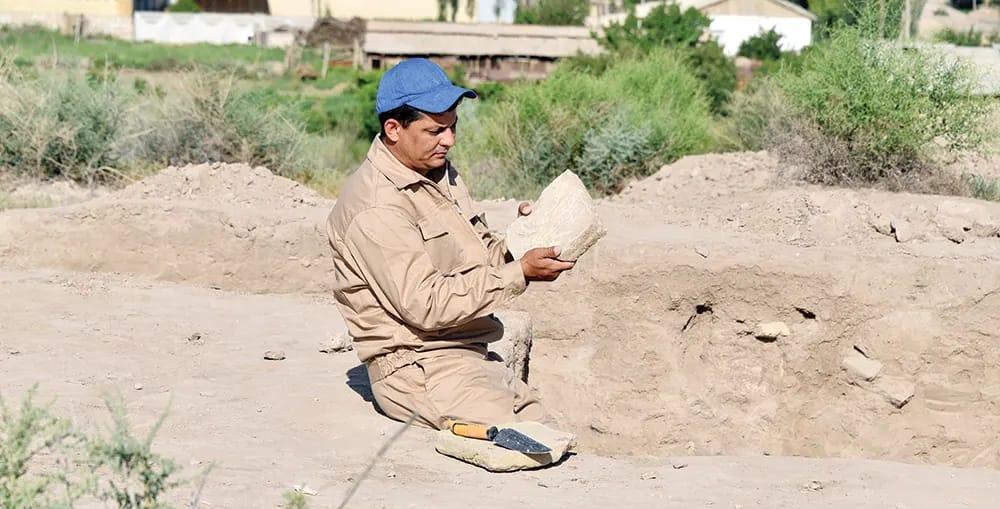
Archaeological excavations have been carried out at the Gyzylaýak historical and cultural site, located within the Gyzylaýak village council area of Kerki District, Lebap Region. The research uncovered a number of artefacts shedding light on the structure of the ancient fortress, the lives of its inhabitants, and their economic activities. The findings were reported by the Türkmenistan newspaper.
The excavation was conducted in a 5-by-5-metre area within the site’s inner fortress, known as the Erk Kala. Researchers investigated cultural layers from different historical periods, reaching a depth of approximately 1.4 metres.
The main objective was to study the material culture of communities that lived in the middle reaches of the Amu Darya during the 1st–4th centuries AD, as well as the development of settled villages that emerged during the Kushan period. The research also sought to determine how the earlier nomadic culture of the Parthian state influenced changes in local ways of life, analyse the collected evidence, and make the findings available for further academic study.
The Gyzylaýak fortress is one of the important historical sites on the left bank of the Amu Darya, near the territory of the Greco-Bactrian Kingdom. Today, the complex survives as a large mound. In ancient times, it was built on an artificially raised platform. Its location at a convenient river-crossing point suggests that the fortress played an important role in monitoring caravan routes.
Historical accounts indicate that the fortress consisted of an inner citadel, or Erk Kala, and a shahristan, the settlement where the population lived. The citadel reportedly stood 10–15 metres high. The fortress had a square layout and was surrounded by a specially constructed ditch for draining water. The shahristan was situated in the southern part of the complex.
The excavations yielded fragments of ceramic vessels, wall remains, and fired bricks of various sizes. Other discoveries included part of a copper coin, a copper bowl dating to the medieval period, a glazed lamp, fragments of a large storage jar decorated with wave patterns, and remains of two types of millstones. Archaeologists also found a small horse figurine with damaged legs and a broken head, along with fragments of various household vessels.
One discovery that particularly attracted the researchers’ attention was a small piece of a silkworm cocoon found among charred twigs. They also established that one twig had been placed crosswise over another.
The discovery of fired bricks in different sizes points to the development of construction techniques at the site. The finds highlight the importance of Gyzylaýak fortress for studying the lives, architecture, and economic culture of ancient settled communities in the middle reaches of the Amu Darya.


Comments
No comments yet. Be the first.