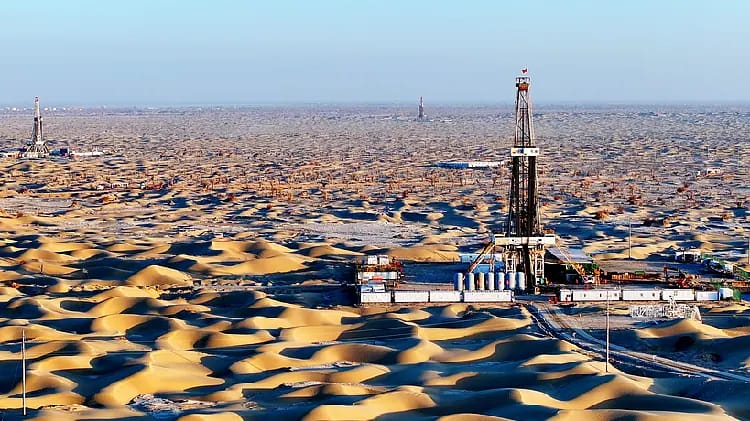
A fragile balance has emerged in the oil market. However, Tuesday clearly demonstrated the difference between the global "storm" and regional stability. While global financial centers are trying to "put out the fire" using reserve oil, the Central Asian region has shown a quality that experts call macroeconomic stability (the ability of this system to maintain balance against external shocks).
The use of Japanese and American reserves has created a temporary "price ceiling." Brent crude today is like a tightly drawn string ready to snap at any moment. It remains unstable around $101–$102.
In economics, this is a classic "wait-and-see market"—a situation where participants delay decision-making until circumstances clear up. International Energy Agency consumers have shown their main advantage, but producers, primarily OPEC+ members like Saudi Arabia and Russia, are maintaining a "strategic pause" worthy of the most skilled players. This is a stalemate where the primary currency is not the dollar, but patience.
The "chess game" in global energy is being played at the highest level. Donald Trump, calling prices a "payment for security," balances between the interests of American consumers and the benefits of the US as an exporter.
Japan was the first country to move from words to action, releasing a record 80 million barrels of oil from its reserves yesterday to protect citizens of the Land of the Rising Sun from the inflationary blow.
China holds a special place in this game. While Washington and Tokyo demonstratively "open" their storage facilities and others make noise, China, like a "quiet giant" whose silence sometimes carries more weight than the loud statements of other capitals, pursues a strategy of accumulating preventive reserves.
Thus, in the first two months of this year, China increased its oil imports by nearly 16%. By early March, its reserves (commercial and strategic) reached a massive size—1.2–1.3 billion barrels. This volume is sufficient for the country to live fully autonomously for 3–4 months.
Furthermore, China took timely preventive measures by switching to supplies from Russia, increasing them to 2.1 million barrels per day at the beginning of the year. For Beijing, this is not just a purchase, but the creation of a "land bridge" of security that does not depend on sea blockades.
As a result, the People's Republic of China, possessing an "oxygen cushion" of more than 1.2 billion barrels of oil, decided to "lock" energy inside the country to support industry and introduced a ban on the export of its own fuel (mainly gasoline and diesel). This ensures internal stability.
Beijing clearly shows: the best protection against "storms" is not just full barrels, but time-tested land routes and reliable partners on the mainland. For our region, this is an important signal—the stability of pipeline connections today is valued higher than any stock market games.
At the same time, OPEC+ maintains a meaningful silence. Their task is "strategic patience." The alliance believes the market is balanced and is in no hurry to open the pipeline valves. In this clash of interests, Turkmenistan confirms its commitment to its course. While giants argue, our country continues to export something valued even higher than a barrel today—predictable stability.
To understand the scale of pressure on an individual, it was enough to look at the gas stations in world capitals on March 17. In London, the price of a liter of gasoline approached $2.50 (a 12% increase in one week), in New York—$1.45 (15%), in Berlin prices exceeded $2.36 (10%), and in Tokyo—$1.12 (including subsidies, a weekly increase of 8%).
In these conditions, the average price in Central Asia, staying stable between $0.55 and $0.65, looks like an economic oasis. It is important to understand: expensive gasoline is "imported inflation" (the rise in prices in the domestic market due to the increased cost of imported goods).
If fuel is four times more expensive in London, then the delivery of any good also becomes several times more expensive. But stable domestic prices in our region do not allow the "fire" of world prices to spread to us.
While gas prices in Europe and Asia continue to rise above $1100, Turkmenistan confirms the advantage of energy sovereignty (complete independence in resource management). The difference between exchange-traded gas and our pipeline system is like the difference between buying water from a random merchant and owning your own artesian well. The party that invested in the "pipe" is protected by long-term contracts and possesses price immunity—protection from market disruptions.
What is the result? Today's crisis is a practical school for our younger generation. It teaches youth to see opportunities where others see chaos.
Looking at these "fluctuations" in the world, future diplomats and economists learn the most important thing—to maintain the stability inherent in masters of Eastern martial arts even in such situations. This is not passivity, but the highest form of complete control over a situation, characteristic of a true "palwan" (hero).


Comments
No comments yet. Be the first.