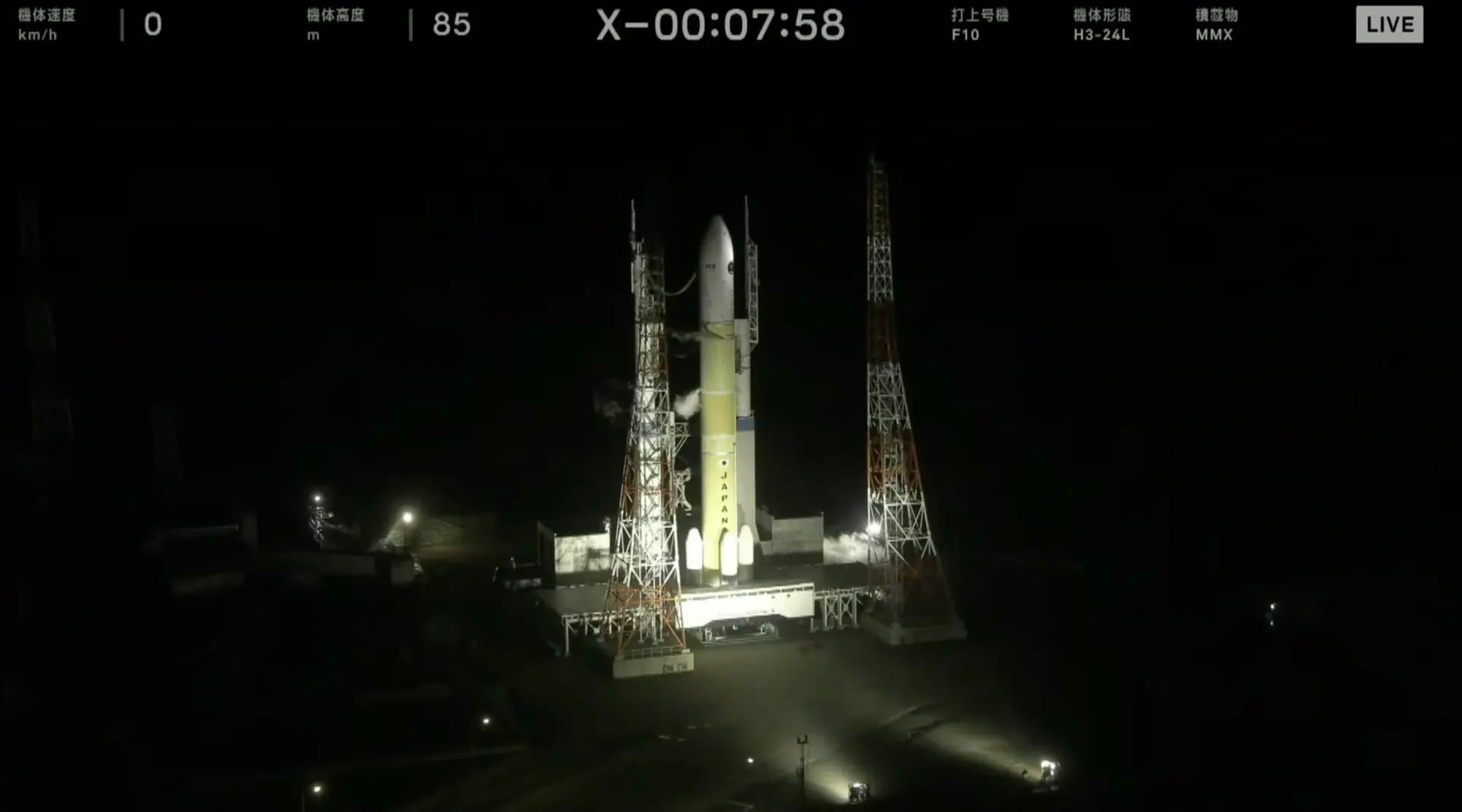
The Japan Aerospace Exploration Agency (JAXA) has successfully launched the MMX spacecraft using an H3 launch vehicle. If the mission is completed successfully, soil samples collected from the natural satellites of Mars will be brought to laboratories on Earth for the first time.
According to the mission plan, the MMX spacecraft will first head towards Deimos, one of Mars’ two moons, and study it. The spacecraft will then approach Phobos and enter its orbit. After that, a specially designed rover intended to collect soil samples will be deployed onto the surface of Phobos.
Landing on the surface of Phobos is considered a technically challenging task. One reason is that the moon has a diameter of approximately 22.5 kilometres. Its gravitational pull is also extremely weak, while the nearby planet Mars has a much stronger gravitational field. These conditions make it difficult to control the spacecraft’s movement and ensure a safe landing on the surface. The BBC reports this.
So far, no soil samples from the moons of Mars have been successfully brought back to Earth. According to the plan, a special capsule containing dust and other materials collected from the surface of Phobos is expected to return to Earth in 2031. Scientists aim to collect approximately 10 grams of material.
Experts believe that even this amount of material could help researchers study the chemical composition of Phobos and determine the origins of both this moon and Mars’ other natural satellite.
The MMX mission is not the first space mission related to Mars. Since 2021, the Perseverance rover has been exploring the planet’s surface and collecting samples for scientific research. The Mars Sample Return programme was planned to bring these samples back to Earth, but its funding was suspended.
Japan’s MMX mission aims to obtain new scientific data that will help researchers better understand the origins and structure of Mars’ moons.






Comments
No comments yet. Be the first.