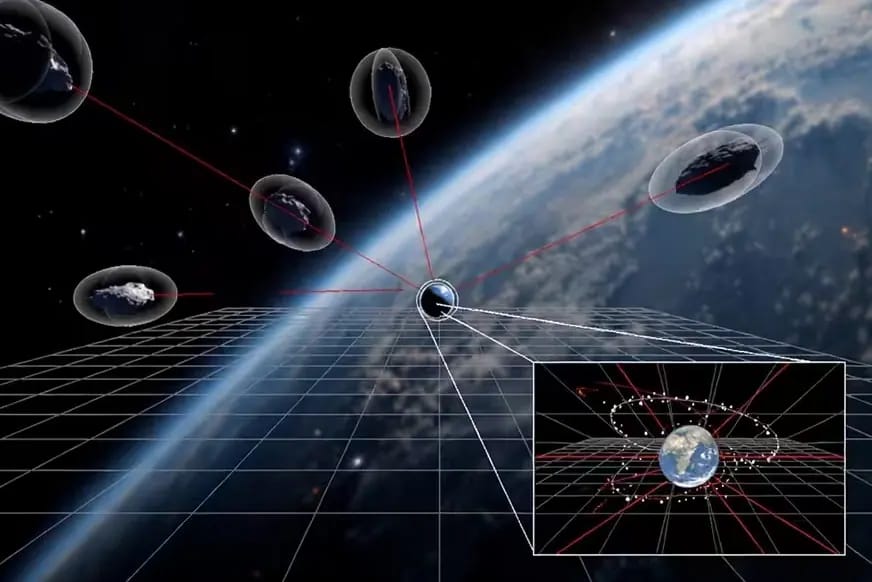
The new NEOForCE asteroid monitoring system detects threats faster and more accurately. Modern planetary defense requires continuous and reliable monitoring of near-Earth objects. The main challenge is the growing uncertainty of asteroid orbits over time, especially without fresh observations.
The French observatory developed NEOForCE (Near-Earth Objects’ Forecast of Collisional Events), which independently assesses the likelihood of asteroid collisions with Earth, complementing existing platforms such as Sentry-II, CLOMON2, and Aegis.
At the core of NEOForCE is the concept of “virtual asteroids” and the Partial Banana Mapping (PBM) method, focusing calculations on orbit regions with the greatest uncertainty, enabling effective analysis even for rare, low-probability collision events.
The system works in several stages: generating virtual asteroids, filtering safe objects, integrating orbits 100 years ahead, identifying key PBM points, and refining collision probability using a modified calculation plane. Tests showed NEOForCE outperforms other platforms.




Comments
No comments yet. Be the first.