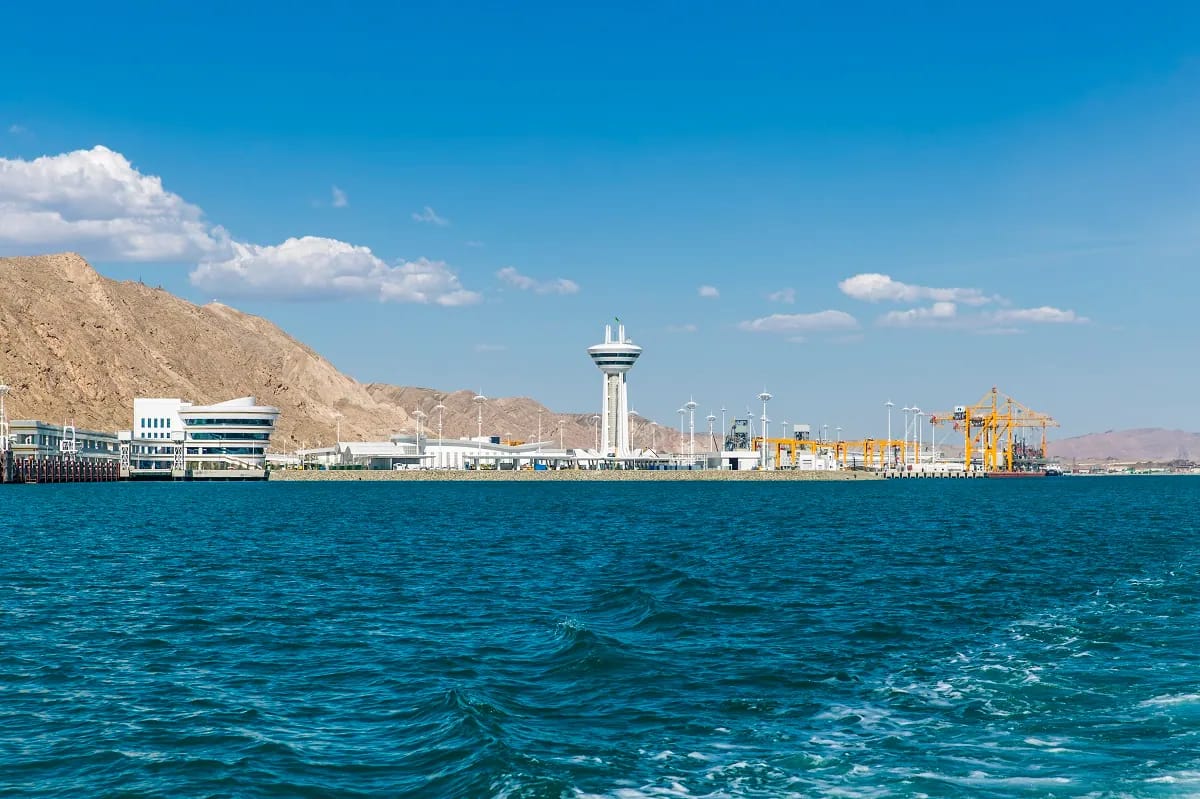
The growth in the volume of cargo transportation along the Trans-Caspian International Transport Corridor — the Middle Corridor — passing through the Caspian Sea, increases the importance of ensuring security and further improving customs control in this direction. In this regard, a practical training session was held with the participation of representatives from the relevant port and customs services of Turkmenistan, Azerbaijan, Kazakhstan, and Tajikistan.
The training was organized with the support of the United Nations Office on Drugs and Crime (UNODC), the World Customs Organization, the United Nations Conference on Trade and Development (UNCTAD), and the Regional Network of Customs Training Centers (IREN).
The practical event connected two important Caspian ports — the Turkmenbashi International Seaport in Turkmenistan and the Port of Baku (Alyat) in Azerbaijan. The first stage of the training took place in Turkmenistan, after which activities continued aboard a ferry crossing the Caspian Sea. The final part of the exercises was held in Baku.
The main purpose of the practical training was to improve the skills of specialists in identifying high-risk cargo, preventing its illegal transportation, and taking immediate appropriate measures when necessary. Special attention was also paid to establishing a prompt exchange of information between port and customs services.
At the final conference of the exercises, Fuad Mammadov, Deputy Chairman of the State Customs Committee of Azerbaijan and Major General, noted that the speed of information exchange between various services and the effective use of digital technologies are essential conditions for the safe and smooth operation of supply chains in the Middle Corridor.
During the theoretical section, experts from the World Customs Organization and Azerbaijani customs officers briefed representatives of Central Asian countries on modern digital solutions used in customs control. Practical scenarios for detecting customs rule violations during maritime cargo transportation were also analyzed.
The joint training of specialists makes it possible to coordinate the work of ports in the Caspian region, increase the efficiency of information exchange, and form unified approaches to cargo inspection.
Holding such events, on the one hand, serves to reduce the risks of illegal cargo turnover and contraband, and on the other hand, creates conditions for reducing the time required for customs procedures by enterprises engaged in legitimate trade.
Considering that the Turkmenbashi International Seaport acts as one of the key transport and logistics hubs in the Middle Corridor, the strengthening of international cooperation among relevant services is of great importance for further developing Turkmenistan's transit and transport potential. Such cooperation contributes to the development of reliable, secure, and efficient transport links between the Central Asia and South Caucasus regions.




Comments
No comments yet. Be the first.