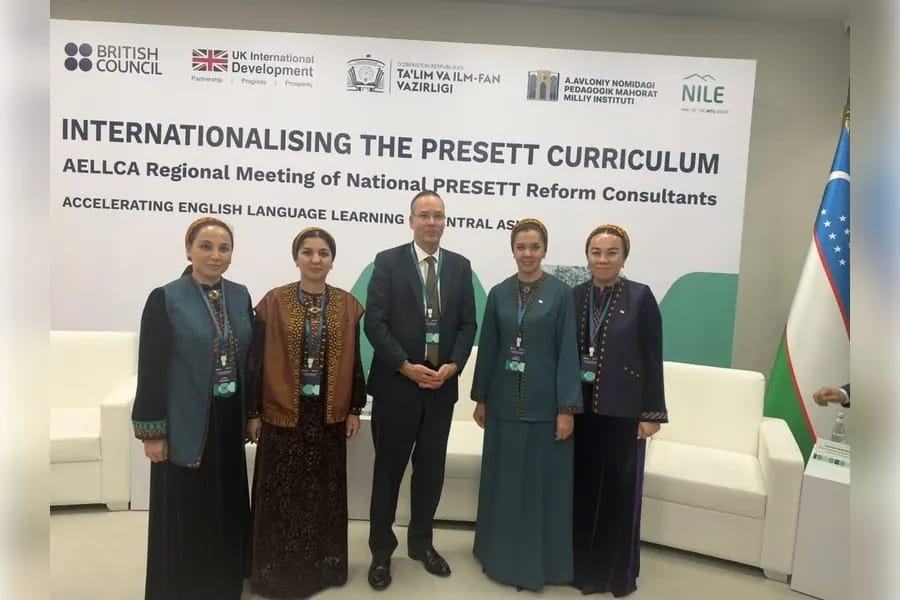
Teachers from leading higher education institutions in Turkmenistan took part in a regional training seminar in Tashkent dedicated to modernising the system for training future English language teachers. Held within the framework of the PRESETT programme, the event was organised as part of the British Council’s AELLCA education project.
The seminar brought together 30 national advisers from five Central Asian countries: Kazakhstan, Kyrgyzstan, Tajikistan, Turkmenistan and Uzbekistan.
Turkmenistan was represented by teachers from Magtymguly Turkmen State University, the Dovletmammet Azadi Turkmen National Institute of World Languages and the Seyitnazar Seydi Turkmen State Pedagogical Institute.
The meeting took place at the Abdulla Avloni National Institute of Pedagogical Excellence. During the event, the Turkmen delegation met with Scott McDonald, Chief Executive of the British Council. The teachers presented draft curricula they had developed. Together with their colleagues, they also discussed the introduction of inclusive and practice-oriented approaches to teaching, as well as the use of modern methods for assessing the professional competencies of future teachers.
In addition, trainers from the Norwich Institute for Language Education (NILE) in the United Kingdom conducted several practical sessions aimed at enhancing the participants’ professional skills.
Participation in this international project has already produced tangible results for Turkmenistan’s education system. In particular, the Dovletmammet Azadi Turkmen National Institute of World Languages has developed an updated curriculum, which was introduced into the educational process from the 2026–2027 academic year. The new programme places particular emphasis on strengthening students’ practical training and applying advanced methods of foreign language teaching.
Such international cooperation and the modernisation of educational programmes contribute to improving the education system and training young professionals with a high level of expertise.


Comments
No comments yet. Be the first.