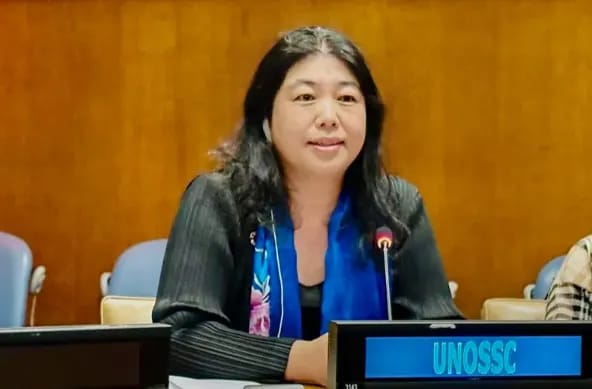
In an interview with the Turkmenistan newspaper, United Nations Resident Coordinator in Turkmenistan Xiaojun Grace Wang stated that Turkmenistan's proposal to establish a Regional Center for Climate Technologies in Central Asia holds immense potential.
According to her, the center could serve as a platform uniting science, policy, financial support, and innovation. It is expected to accelerate practical solutions in areas such as climate change adaptation, water resource management, renewable energy, and ecosystem protection.
The UN Coordinator also emphasized that the United Nations fully endorses Turkmenistan’s leadership in advancing cooperation across the Caspian region, noting that complex modern challenges cannot be resolved by any single country alone.
She highlighted that the Convention on the Legal Status of the Caspian Sea and the Tehran Convention provide a vital framework for collective action. Furthermore, the UN General Assembly resolution titled "2028 — International Year of International Law," adopted on Turkmenistan's initiative, reinforces that effective cooperation depends on strong institutions, shared commitments, and respect for international law. Wang also noted that the Awaza Political Declaration and the Awaza Program of Action, adopted during the 3rd UN Conference on Landlocked Developing Countries on the Turkmen Caspian coast, significantly contribute to these ongoing efforts.


Comments
No comments yet. Be the first.