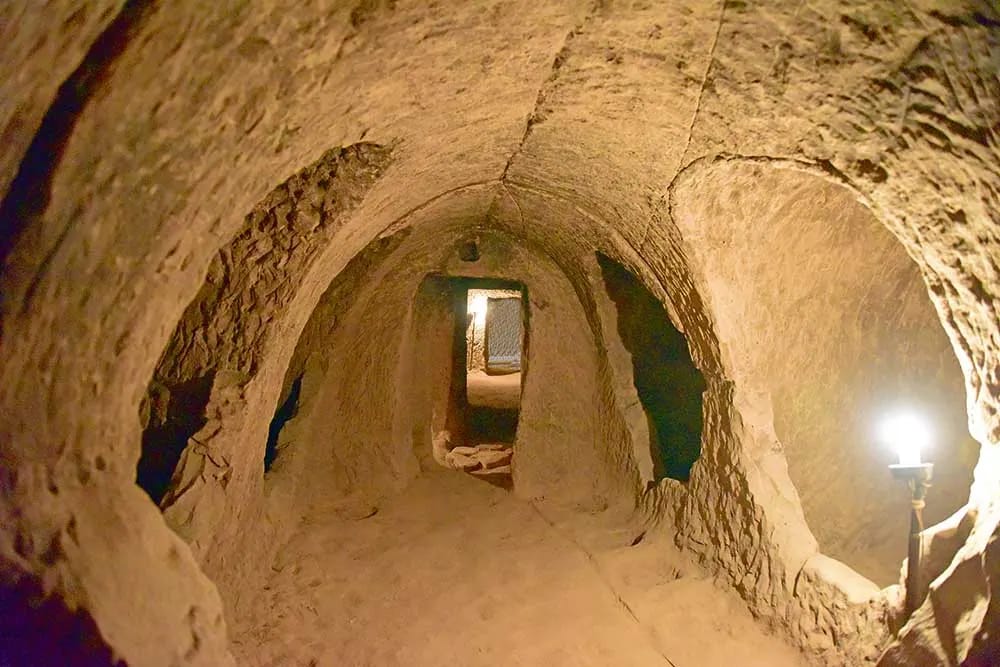
The historical monument “Yekegowak”, one of the valuable examples of Turkmenistan’s historical and cultural heritage, is located on the banks of the Murghab River in Mary Province. It forms part of a multi-level cave complex created in the Middle Ages by skilled craftsmen, who carved out the sandy layers of the rock.
Hero-Arkadag provides a detailed account of this remarkable monument in the second volume of his book “Turkmenistan — The Heart of the Great Silk Road”. As noted in the book, caravans travelling north along the left bank of the Murghab River passed by a cave complex located in the vicinity of Dashköpri and Tagtabazar. These caves were carved into the thick sandstone layers of a steep hill on the right bank of the river.
“Yekegowak”, one of the distinctive examples within this complex, reaches a length of 37 metres. It is shaped like a straight, elongated corridor, with its upper section carved into a vaulted form. Rooms are located on both sides of the corridor. Some of them also contain deep, circular wells. Stone spiral staircases were built to provide access to the upper level of the cave complex.
According to scholars, the practice of creating dwellings in underground caves was widespread in this region in ancient times. The medieval Arab geographer Qudama also wrote about one of the settlements in the Murghab region, noting that its inhabitants lived in houses located inside the mountain caves.
Today, the historical monument “Yekegowak” is one of the sites attracting tourists interested in the country’s past, ancient architectural traditions and the craftsmanship of its ancestors.

Comments
No comments yet. Be the first.