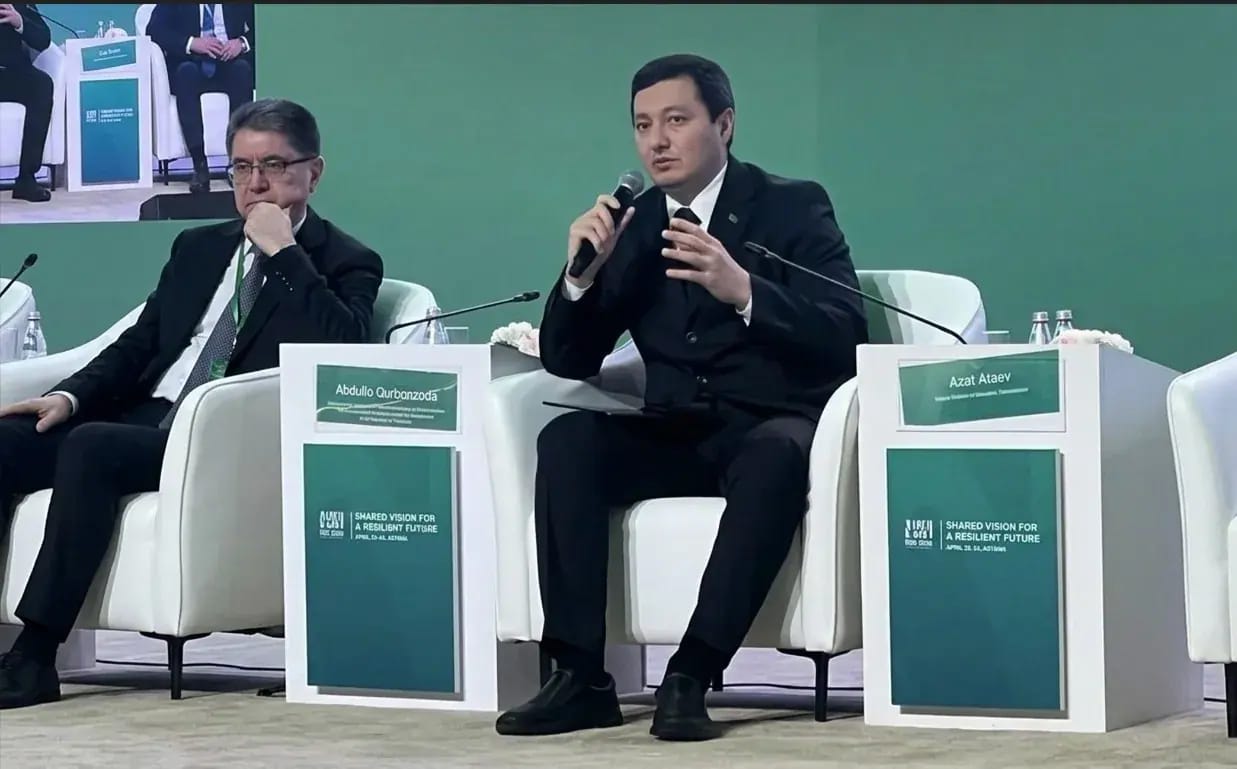
Within the framework of the Regional Environmental Summit (RES 2026) at the Central Asian Climate Change Conference (CACIC-2026) in Astana, the Deputy Minister of Education of Turkmenistan, Azat Atayev, discussed the measures the country is taking in the field of climate education.
Speaking at a high-level plenary session, the Deputy Minister declared Turkmenistan's firm position: the education system is viewed not as a secondary sector, but as a key link in implementing environmental tasks. A. Atayev emphasized that the transition to nature-like technologies and emission reductions should not contradict economic growth but rather be carried out in harmony with it.
Regarding specific steps, the Deputy Minister reported that a professional skills assessment for the green transformation was conducted in the country's higher education institutions following recommendations from the UNDP and the European Training Foundation. Based on the results, an Atlas of Future Professions was compiled, covering 156 specialties across 11 economic sectors. For most of these, climate and ecology-related competencies were integrated into the professional requirements.
At the school level, as early as 2019, the "Climate Box" was distributed to all schools across the country with UNDP support. In 2022, methodological materials were developed for five subjects, enabling teachers to integrate climate themes into their lessons. In 2025, with support from UNICEF, similar materials were prepared for preschool institutions.
Addressing the regional level of climate challenges, A. Atayev highlighted the initiative of the President of Turkmenistan to establish a Center for Climate Technologies during the plenary session, noting its significance for long-term climate planning and the fulfillment of Nationally Determined Contributions (NDC) goals.

Comments
No comments yet. Be the first.