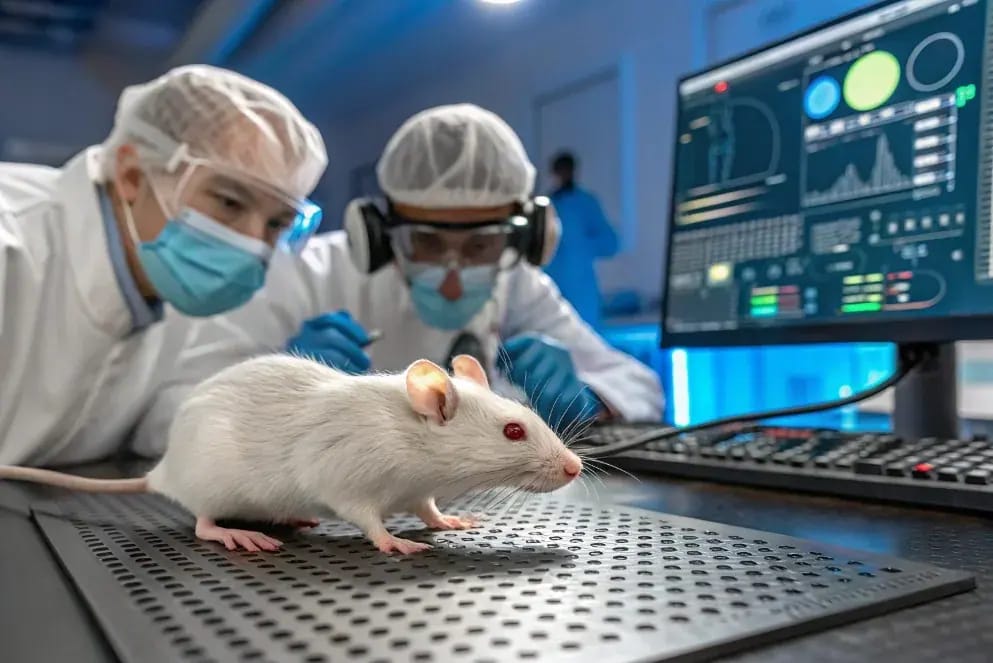
As a result of an innovative scientific study conducted by an international team of scientists, a specially designed flexible eye implant helped restore the vision of blind mice and enabled them to perceive near-infrared light. This new device converts infrared rays into electrical signals and transmits them directly to the optic nerves. This project, published in the renowned journal "Nature Electronics", could open a completely new and safe chapter in the future treatment of people deprived of vision.
Usually, certain genetic disorders or age-related diseases lead to the death of the eye's photoreceptors (i.e., light-receiving cells), resulting in total blindness. In such cases, other cells and nerve systems of the eye retain their health and their ability to send signals to the brain.
For many years, engineers have been trying to create microfluidic microelectronic systems to replace dead receptors. However, the biggest problem with previous-generation prostheses was that they were made of rigid materials. Hard electrodes damaged the soft tissues at the back of the eye, causing swelling and inflammation. They also reacted to ordinary visible light, which obscured even the little natural vision remaining in the patient.
The authors of the new scientific work proposed using near-infrared rays, which are invisible to the human eye and not used by the natural eye. The engineers constructed a very thin film consisting of silicon transistors and microelectrodes emerging from it. The contacts inside the eye were made of liquid metal molds formed from a gallium and indium alloy.
This metal alloy is in a liquid state at human body temperature, is thousands of times softer than ordinary conductors, and is very close to the flexibility of the eye's biological tissues. To further improve electrical conductivity, the tips of the metal pillars were coated with platinum, and a special filter that passes only infrared rays was placed on top.
Laboratory tests were successful
The safety of the new technology was first tested on a laboratory model of human pigment cells and on an isolated retina. It was determined that the device has no toxic toxicity for living tissues and is fully stable in the moist environment of the eye.
Subsequently, the artificial retina was placed into the eyes of three healthy and three genetically completely blind mice. When scientists flashed infrared light into the eyes of the mice, the formation of electrical impulses was recorded in the visual center of the blind mice's brains.
In addition, an experiment was conducted to test the behavior of the animals. Mice were trained to lick water from a special tube whenever they saw any light signal. With the help of the artificial eye, the blind mice managed to perceive infrared rays just as accurately and reliably as healthy mice see ordinary light.
A promising path of science
Although research has proven that the signal is transmitted from the eye to the brain, scientists do not yet know how this technology will fully affect humans. The impulse traveling to the brain might not restore a complete and clear picture of the world in the human mind, but rather resemble irregular white spots. That is, whether the patient will see in a thermal imaging (thermolyzion) format still remains unknown.
Nevertheless, the integration of liquid metals into medicine and the operation of transistors in invisible spectrums provide medicine with a new tool in the fight against blindness. Before applying the technology to humans and larger animals, engineers plan to significantly reduce its energy consumption and conduct long-term trials.








Comments
No comments yet. Be the first.