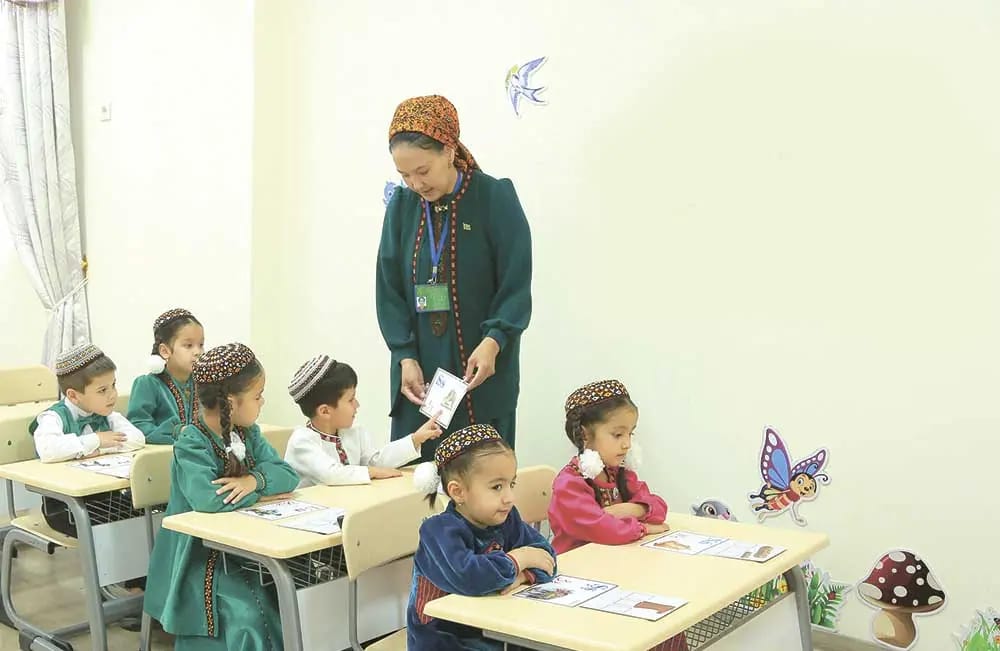
Jemile Gaipowa, educator at the 5th kindergarten-nursery of the Kerki district: For education workers who teach and raise toddlers in preschool institutions, the main task is to raise a generation in accordance with the Turkmen national spirit and, at the same time, the requirements of the era. In particular, developing the speech of toddlers is considered one of the primary tasks. Therefore, we pay special attention to developing the speech of toddlers. For their speech to be perfect, it is of great importance to develop speech and organize literature classes using active methods in line with modern requirements. The richer, more cultured, artistic, and pleasant the speech of the educator or teacher, the more the child's vocabulary improves on that basis. A child pays great attention to the speech of the educator or teacher. By imitating those around them, their parents, and adults, they quickly adopt the rules of correct speech and speech culture. In life and in our work experience, we frequently hear from parents that children at home, imitating their educator, organize interesting lessons with their dolls.
One of the perfect methods for developing children's speech and vocabulary is to use works of folklore. Various forms of folklore reflect the reality of life through artistic words, giving much meaning in few words. In daily lessons, toddlers should be taught fairy tales, riddles, counting rhymes, and tongue twisters. Based on this, the child should be assessed and encouraged. One of the most important tasks for kindergarten educators and teachers is to find and correct deficiencies in a child's speech in time and to encourage the child. In kindergarten-nurseries, developing the speech of toddlers is the duty of the educator and teacher.
Fairy tales as a form of folklore are most interesting for children. In developing children's speech through fairy tales, it is appropriate to first give children a brief understanding of the importance of fairy tales according to their age characteristics. It should be explained that in fairy tales, along with human characters, there are also images of various animals, plants, and imaginary creatures. In this way, children enter the interesting world of fairy tales. We use several methods in developing children's speech and vocabulary through fairy tales. The first of these is teaching children to tell stories in the Turkmen literary language. The educator should read and tell the story clearly. The second method is the method of exchanging questions and answers about the fairy tale with the toddlers. Through questions and answers, the content of the story becomes even clearer. Here, the ability, talent, and skills of each child for literary speech are born and revealed. Children are interested not only in the external side of events in the story but also in their meaning and cause. "Why?", "What is it made of?", "Why is this necessary?" and similar ones are common questions from children, and the educator must support the child's curiosity to develop their speech. As much as possible, the educator should try not to leave the child's questions unanswered.
When you teach fairy tales by dramatizing them, children participate with great enthusiasm. Teaching them to enter a character is a necessary and useful method in education and upbringing, in perfecting correct sound pronunciation skills, and in developing vocabulary. Through fairy tales, not only is children's speech developed, but moral qualities and good character can also be nurtured in toddlers. By citing the characters of animals in stories as examples, it should be explained that one should not oppress the weak, should not be cunning or a deceiver like a fox, should not laugh at a friend, and should do what elders say. Through the fairy tale "How Bread Turned into a Child," a desire to work should be created in toddlers; through the tale "The Ant and the Dove," friendly relations should be nurtured; and through the tale "Shared Crop," a desire for honest labor should be fostered. Through fairy tales, noble qualities such as the desire to work, helping adults, and respecting parents can be cultivated in children.



Comments
No comments yet. Be the first.