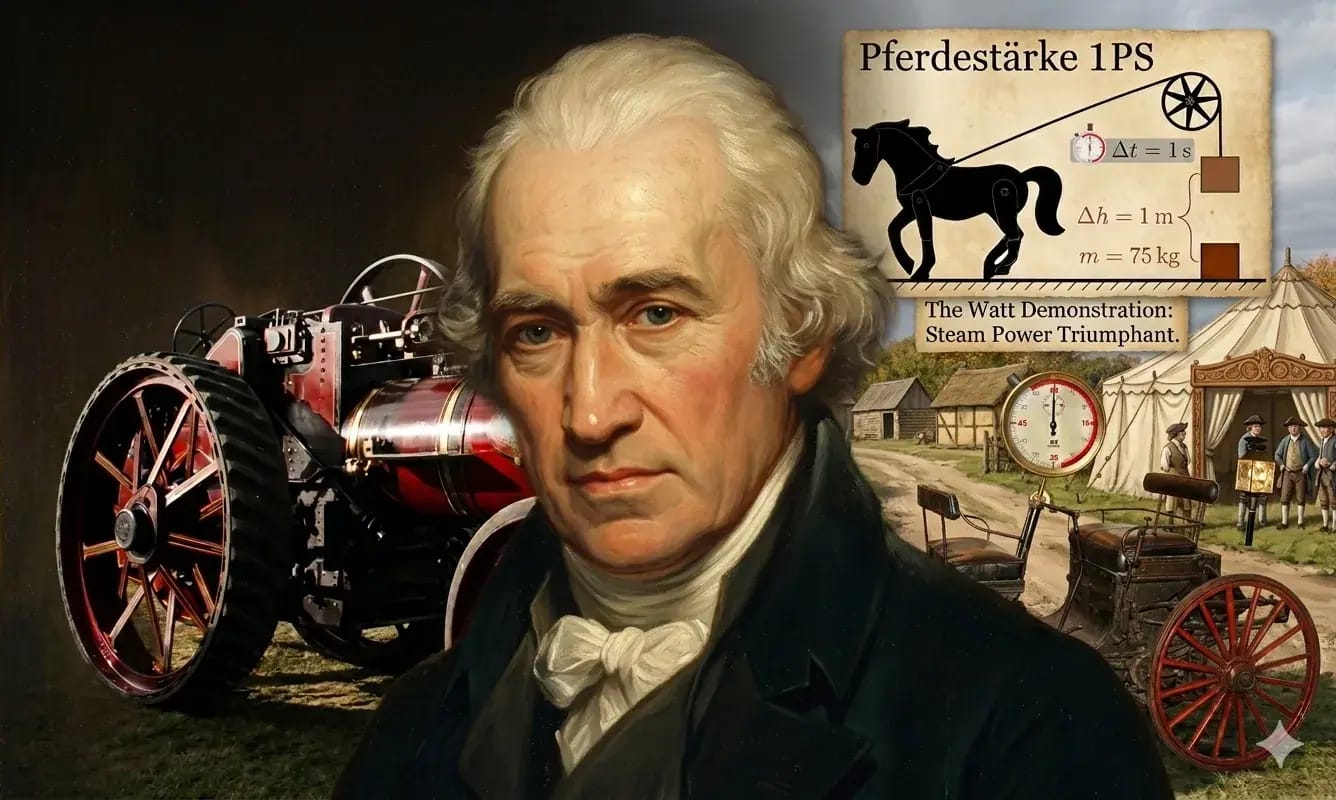
Undoubtedly, the most widely used and accepted unit of measurement in the automotive world is "horsepower." We characterize the capabilities of even the most modern, super-fast vehicles with phrases like "300 horsepower" or "500 horsepower." But in the era of advanced digital technologies and the space age, why do we still compare engine power to animals?
1. It All Started with Marketing
In the 1780s, Scottish engineer James Watt wanted to sell his newly improved steam engine. At that time, horses performed all the heavy labor. Watt had to prove that his machine was more productive than the horses in coal mines. To make it understandable to people, he decided to explain his machine's power in terms of the "number of horses." This became one of the most successful marketing moves in history.
2. Mathematical Calculation
Watt measured how much power a single horse exerted during normal work. According to his calculations, an average horse could lift a 75-kilogram load 1 meter high in one second. This indicator was recorded in physics as "1 horsepower" (1 hp).
Fun Fact: Actually, a horse can exert up to 15 horsepower when putting in short-term (maximum) effort. However, Watt based his unit on the steady, average power over a regular workday.
3. What Does Horsepower Mean in Engines?
In an engine, horsepower is the work it can perform within a specific unit of time.
- Acceleration: The higher the horsepower, the faster the vehicle can gain speed.
- Top Speed: A vehicle's ability to reach its maximum speed depends directly on the amount of horsepower.
Although car manufacturers now use Kilowatts (kW) in official documents (for example, $1 \text{ hp} \approx 0.746 \text{ kW}$), "horsepower" remains more understandable and impactful in the minds of drivers.
4. Modern Times and Electric Vehicles
Today, Tesla, Lucid, and other electric vehicles also display their power in "horsepower." This is not just a historical tradition; it is a common language that allows buyers to compare the power of electric cars with gasoline-powered ones.






Comments
No comments yet. Be the first.