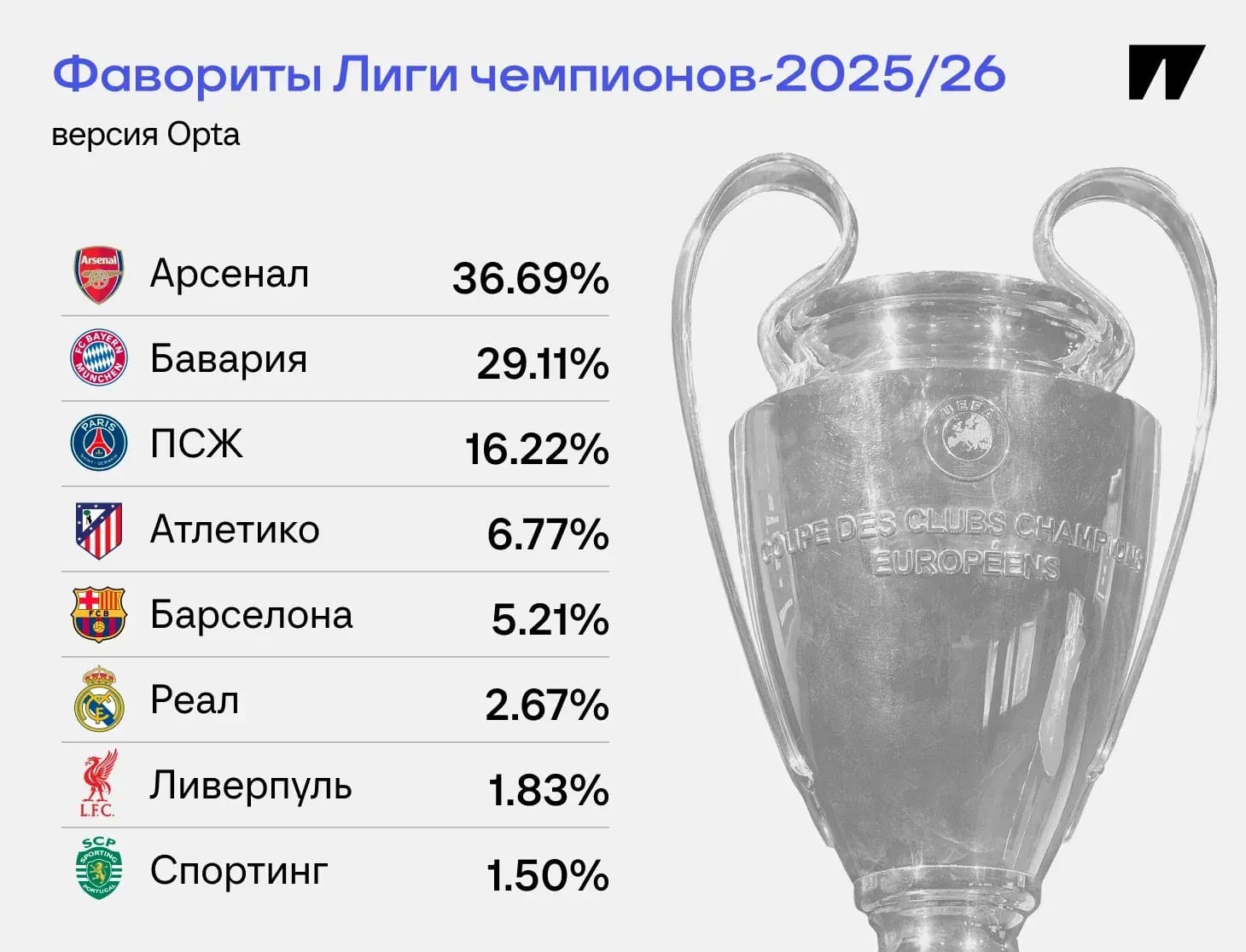
The opening matches of the 2026 Champions League quarterfinals may have lacked blowout scores, but they were rich in tactical surprises. The main takeaway: giants Barcelona and Real Madrid are now in the role of chasers, facing extremely uphill battles.
In the Atlético vs. Barcelona (2:0) matchup, the Catalans' chances of advancing have plummeted to 25%. History is stacked against the Blaugrana: since the inception of the current UCL format, only Manchester United (in 2019) has managed to overturn a two-goal home defeat. Nevertheless, analysts view Barça as the "strongest" among the underdogs, citing Pau Cubarsí’s red card as a pivotal "what if" factor.
The situation is even bleaker for Liverpool against PSG (0:2), with only a 19% probability of success. Even the "Anfield magic" is failing to convince experts after Safonov’s solid performance and Kvaratskhelia’s goal-scoring form in Paris.
However, the most critical situation belongs to Real Madrid (16% vs. Bayern’s 84%). Losing 1:2 at the Bernabéu is often a death sentence against a Bayern side that historically progresses 30 out of 31 times after winning the first leg away.
Amul Info Analyst Opinion
Why is Barça considered the most likely to pull off a comeback (25%) despite trailing 0:2? The answer lies in the performance metrics before the red card. Unlike Liverpool, who looked toothless in Paris, Barcelona dominated the early stages against Atlético and created high-quality chances. If Hansi Flick adjusts his tactics and Marcus Rashford converts even half of his opportunities, Atlético’s defense could crack.
However, the big picture is alarming for the old guard. Arsenal and Bayern Munich currently look like the two primary contenders for the final. Meanwhile, Atlético has made the most significant jump in the power rankings, soaring from second-to-last to fourth place. We are witnessing a shift in the European hierarchy as traditional favorites struggle to keep pace.
Source
Info: Venera Kravchenko, Guest Columnist



Comments
No comments yet. Be the first.