The implementation of project and scientific work related to the development of gas fields in Eastern and Central Turkmenistan is one of the main areas of activity of the Research Institute of Natural Gas of the State Concern “Turkmengaz”. For more than forty years, the institute has been conducting comprehensive research in geological exploration and gas reserve estimation, well drilling design, natural gas preparation, transportation and processing, environmental protection, as well as feasibility studies of oil and gas projects.
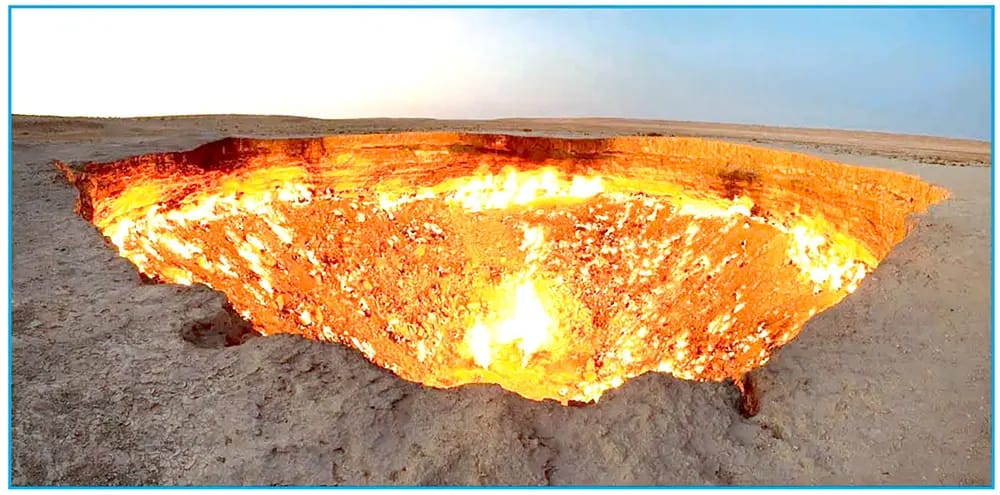
A special place in the institute’s research is occupied by a unique natural and technogenic site — the Darvaza Crater, known as the “Shine of the Karakum Desert”. It is located in the Central Karakum Desert, within the Chaljulba and Zakly-Darvaza group of fields, approximately 270 kilometers from Ashgabat. Since 1963, natural gas has been continuously escaping from underground and burning at this site.
The crater, about 60 meters in diameter and nearly 20 meters deep, was formed as a result of the collapse of an exploratory well drilled at a gas field. At the time of the accident, in order to prevent poisoning of people and animals, it was decided to ignite the escaping gas. It was assumed that the fire would extinguish within a few days — either the gas reserves would burn out or the gas-bearing formation would be flooded, as happened at neighboring fields where the Shikh (water-filled) and Darvaza (mud-filled) craters were formed.
The institute’s specialists thoroughly studied the geological structure of the Zakly-Darvaza group of fields. Their distinguishing feature is the presence of thin, low-productivity layers located at depths from 200 to 950 meters, intersecting with water-bearing and dense rock formations. At present, the Darvaza, Takyr, Shikh, Shikhyany, Chaljulba, Goyun, Topjulba, Toparjulba and Chemmerli fields are being industrially developed. Gas production is carried out using 45 wells.
Hydrodynamic interconnection between certain layers and fields has been identified. As a result of drilling exploratory and production-evaluation wells, rock sections down to the crystalline basement have been revealed in Central Turkmenistan. The platform consists of Paleozoic formations — granites, granite porphyries, tuffs and rhyolitic tuff lavas. Their age is defined as pre-Permian to Triassic, with the maximum exposed thickness reaching up to 120 meters.
Sediments of the Cretaceous system are represented by a complete stratigraphic sequence and include both marine and continental deposits — from Valanginian and Hauterivian to Barremian, Aptian, Albian, Cenomanian, Turonian, Senonian and Danian stages.
Contrary to initial assumptions, the burning of the Darvaza Crater has continued for several decades. This phenomenon has a negative impact on the environment and leads to the loss of valuable energy resources. Therefore, the leadership of the fuel and energy sector decided to involve the scientific community in finding effective ways to prevent uncontrolled gas emissions.
Previously, several attempts were made to investigate the crater and the аварийная well. Specialists of the “Oil and Gas Safety” Department of the State Concern “Turkmengaz” examined the bottom of the crater in the hope of finding the preserved cemented section of the well, which would have allowed the installation of wellhead equipment and the regulation of gas flow. However, due to numerous burning vents on the crater surface, locating the well bottom proved impossible.
Data from operating wells confirm the presence of gas flows between intersecting layers. Despite the relatively small reserves of the field opened by the exploratory well, this explains the continuous burning of the crater.
Taking into account the identified geological and hydrodynamic characteristics, specialists of the Research Institute of Natural Gas proposed drilling a production-evaluation well at the Chaljulba field. By extracting gas from the productive layer, it became possible to change the direction of filtration flows and significantly reduce the supply of gas to the crater.
The implementation of this scientifically substantiated solution will eliminate atmospheric gas emissions, reduce environmental damage, and ensure the rational use of Turkmenistan’s natural resources.


Comments
No comments yet. Be the first.