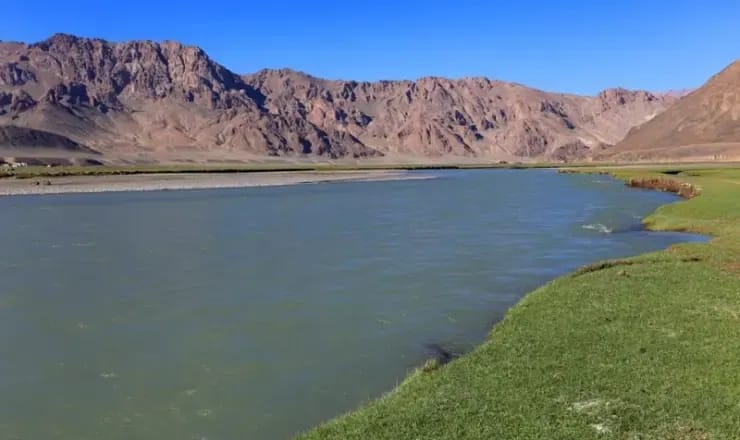
The German Agency for International Cooperation (GIZ) has published a final report containing the results of an assessment of climate risks in five river basins in Central Asia. Among them is the Murghab River Basin, one of the important water sources of Turkmenistan.
The assessment was conducted within the framework of GIZ’s regional programme aimed at managing climate risks in Central Asia. The study covers the basins of the Murghab, Shahimardan, Chu, Zeravshan and Isfaramsoy rivers.
The report analyses the main climate hazards for the region, including floods and high-water events, flooding caused by heavy rainfall, flash floods, droughts, extreme hot weather and heatwaves.
The potential impacts of climate risks on agriculture, water resources, soil and land resources, ecosystems and biodiversity, as well as infrastructure, were examined separately.
The Murghab Basin, located in the territory of Turkmenistan, occupies a special position as one of the strategically important water-management regions. For each of the five basins, areas, economic sectors and population groups that are more vulnerable to climate change were identified.
The report notes that regular climate-risk assessments are an important tool for preparing development plans, making decisions and directing appropriate financial resources at international, regional and local levels.
Such an approach makes it possible to integrate climate scenarios into national and local development strategies, forecast water shortages and droughts, and reduce potential losses in agriculture.
Experts propose a number of measures to adapt to climate risks. These include establishing early warning systems, strengthening riverbanks, enhancing flood protection measures, protecting soils, using water resources efficiently and restoring natural ecosystems.
It is also recommended to increase the knowledge and awareness of local specialists and residents in relevant areas. The recommendations are addressed to relevant ministries and sectoral government bodies, basin organizations, scientific institutions, local authorities and public organizations.
The report also emphasizes the importance of active participation by local communities, farmers, water users, representatives of pasture management, women and young people in developing measures to address climate risks.
The findings of the study provide an information base for developing long-term plans for efficient water-resource management and adaptation to the impacts of climate change in Central Asia.




Comments
No comments yet. Be the first.