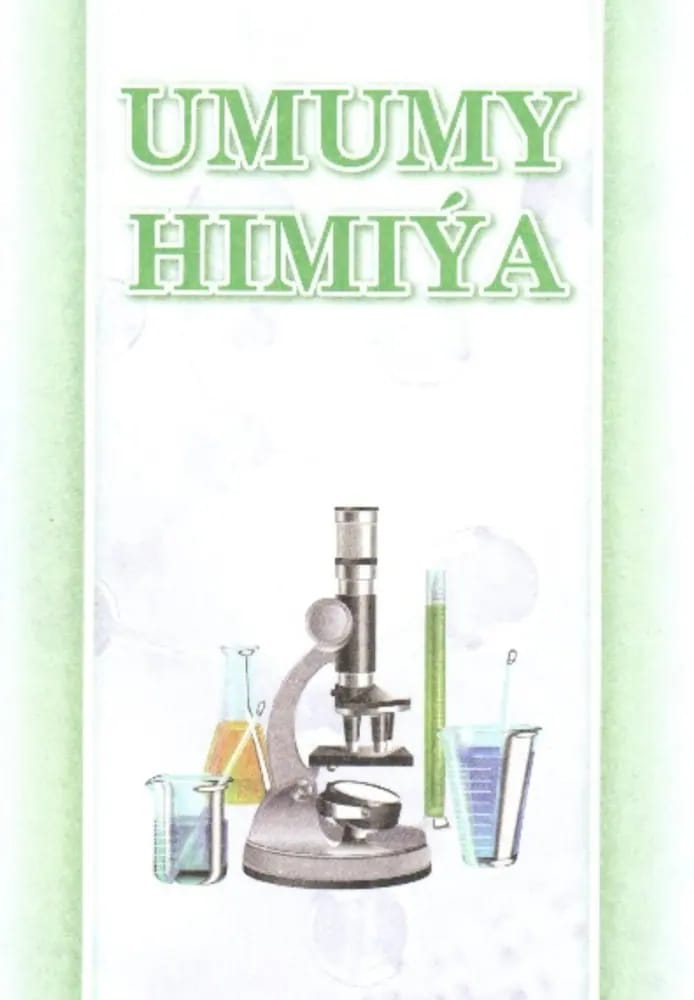
Caring for people and protecting their health is considered one of the most important priorities in our country. Chemistry's achievements in developing new substances and materials—such as medicines, polymers, and polymer materials—make it possible to prevent and treat numerous diseases.
To become a highly skilled healthcare professional, it is essential to understand the effects of various chemical substances and phenomena on human health and the environment, and to possess deep and comprehensive knowledge of chemistry. Students of medical vocational schools, regardless of their chosen specialty, must receive in-depth education in chemistry and master the methods of performing practical laboratory work.
Recently, the Turkmen State Publishing Service released the "General Chemistry" textbook for medical vocational schools (authors: Amangulyyew M., Altyyew A., Nurgeldiyew M., Rozyyewa T.). The book provides theoretical concepts of inorganic chemistry, information on chemical elements and their compounds, and relevant data on organic chemistry.
The textbook consistently describes theoretical concepts of inorganic chemistry, including atomic structure theory, isotopes, electron motion in atoms, quantum numbers, electron configuration of atomic orbitals, the periodic law and the periodic system of elements, chemical bonding, main groups of inorganic compounds, complex compounds, dispersed systems, solutions, reactions in solutions, chemical kinetics, and chemical equilibrium.
From organic chemistry, it accurately describes the structure of organic compounds, homologous series, isomerism, saturated hydrocarbons, cycloparaffins, their synthesis, properties and applications, as well as arenes, benzene, the theory of aromaticity, and the chemical properties of arenes.
The textbook is intended for students of medical vocational schools, but teachers and students of other specialized secondary schools, as well as students in preparatory courses, can also benefit from it.





Comments
No comments yet. Be the first.