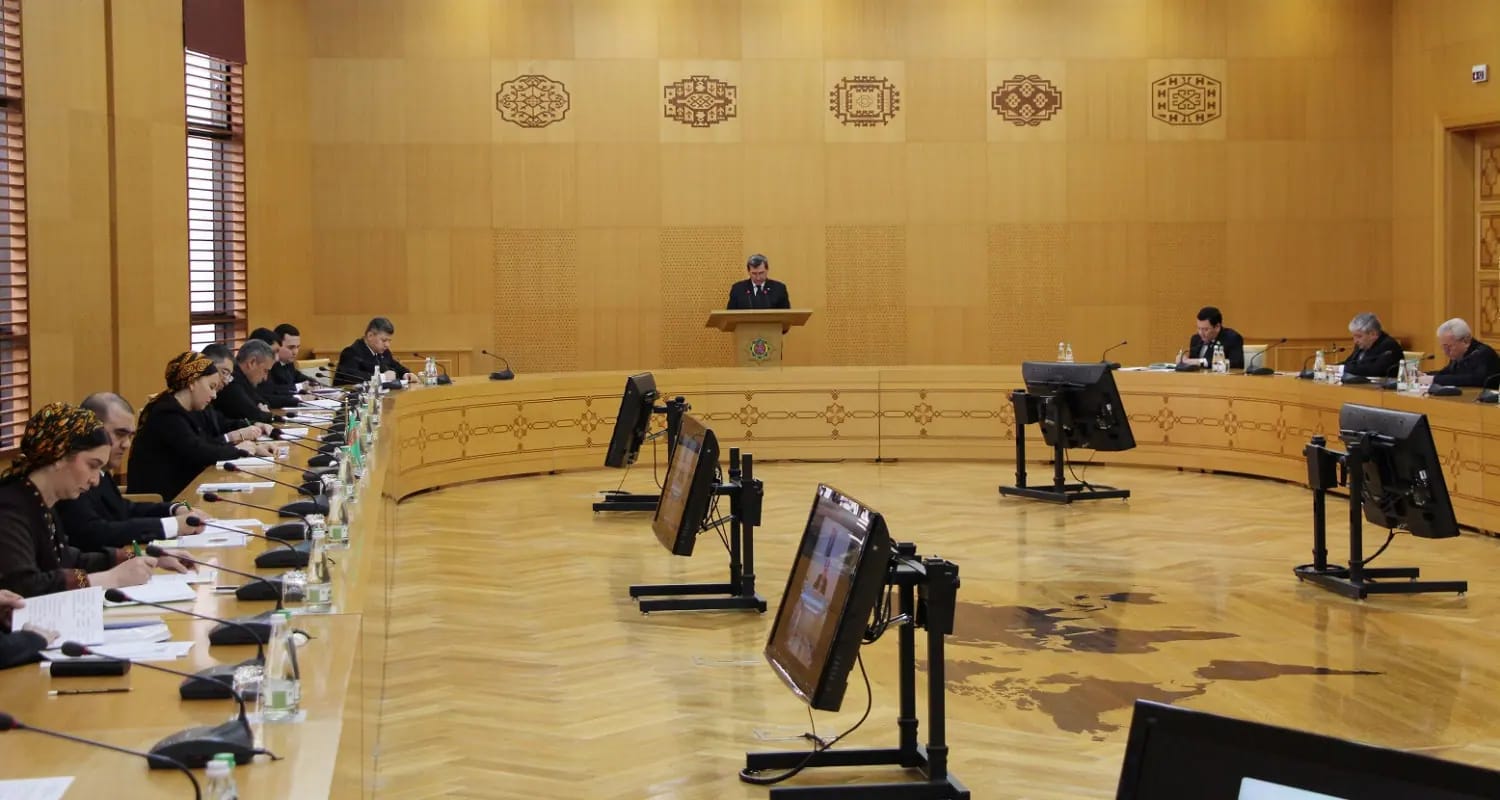
Yesterday, following the instructions of Honorable President Serdar Berdimuhamedov, the regular meeting of the National Commission of Turkmenistan for the United Nations Educational, Scientific and Cultural Organization (UNESCO) was held at the Ministry of Foreign Affairs. It was attended by several Deputy Chairmen of the Cabinet of Ministers, heads and representatives of relevant ministries and sectoral departments, public organizations, and mass media.
During the meeting, issues of developing cooperation within this specialized UN agency were reviewed, and future directions for interaction were determined in connection with proposals for including the national values of our country in the UNESCO Representative List of the Intangible Cultural Heritage of Humanity.
Furthermore, in accordance with the instructions of the Head of State, information regarding the results of the activities carried out by the National Commission of Turkmenistan for UNESCO last year and the tasks set in the Plan for 2026 was presented.
Along with this, it was noted that in 2025, dozens of digital meetings and consultations were held with representatives of UNESCO and its regional structures, during which promising directions for effective cooperation in the fields of science, education, culture, and ecology were discussed. Foreign trips were organized to participate in international and regional conferences and training seminars held by UNESCO and its regional office in Almaty.
As is known, in Turkmenistan, special importance is attached to the global promotion of our national heritage, craftsmanship traditions, and decorative-applied arts, as well as the development of various forms of art. As a result of the state policy initiated by the National Leader of the Turkmen people, Chairman of the Halk Maslakhaty of Turkmenistan Gurbanguly Berdimuhamedov, and successfully implemented under the leadership of Honorable President Serdar Berdimuhamedov, wide-ranging work is being carried out to increase the spiritual and intellectual potential of Turkmen society, improve our national culture, and protect and carefully preserve our historical-cultural and natural monuments.
Our rich cultural heritage is a unified system of unique material and spiritual values passed down from generation to generation by our people. From this perspective, our country attaches special importance to the consistent expansion of cooperation with UN structures, including UNESCO. Turkmenistan has been a full member of this organization since 1993. This major specialized branch of the UN plays a vital role in international efforts to protect cultural monuments and natural landscapes, creating favorable conditions for an open dialogue based on respect for universal values. The functioning of the National Commission of Turkmenistan for UNESCO is also clear evidence of the great importance given to long-term future relations.
It should be noted that within the framework of long-standing cooperation, great success has been achieved in implementing UNESCO's goals in our country and increasing the cultural, educational, and scientific potential of our state. This also applies to issues related to the international recognition of the material and intangible cultural heritage of Turkmenistan.
By acceding to the UNESCO Conventions on the Protection of the Intangible Cultural Heritage, the Protection of the World Cultural and Natural Heritage, and many other documents, Turkmenistan actively participates in international efforts to implement their provisions. Wide-ranging work is carried out to preserve historical-cultural and natural monuments, which are an integral part of world civilization, for future generations. A clear example of this is the inclusion of several unique historical sites located in our country—Ancient Merv, Kunyaurgench, and the Parthian Fortresses of Nisa—in the UNESCO World Heritage List.
In 2025, within the framework of the UNESCO Geoparks program, work was carried out to create geoparks that include natural and cultural monuments and landscapes of international geological significance. The main goal of the program is to create a global territorial system that uses and promotes geological heritage in accordance with local development characteristics. The creation of national geological parks in Turkmenistan is one of the promising resources for environmentally friendly, non-industrial development. Their main goal is to protect the geological and non-geological heritage of the region and to use them as a platform for developing science and tourism.
Our country possesses unique geological objects. In this regard, the canyons on the southeastern coast of the Garabogaz Bay and the mud volcanoes, which have the status of international geological heritage, are of particular interest. The creation of geoparks in these regions will be significant not only for protecting natural resources but also for supporting the local economy, creating new jobs, developing ecotourism, and increasing public awareness about the significance of the region's geological heritage.
The opening of 2 UNESCO chairs and 6 clubs in Turkmenistan's higher education institutions, as well as the inclusion of 6 secondary schools in the UNESCO Associated Schools Network, is of great importance for forming the creative and scientific-research activity of youth and increasing their knowledge about the cultural values and traditions of their country. Students of secondary and higher education institutions, master's students, and teachers deeply study and promote UNESCO's humanitarian principles and the goals of peace and mutual understanding. Intercultural relations, education in the spirit of respect for other cultures, preservation of cultural and historical heritage, and environmental protection are among the primary tasks.
As noted by the speakers, last December, the city of Ashgabat, which created necessary conditions for citizens of all ages to learn and acquire knowledge throughout their lives and achieved high results in developing the country's science and education system, was included in the UNESCO Global Network of Learning Cities. This is clear evidence of the international recognition of the efforts made in Turkmenistan to form a society oriented toward developing human potential and adopting knowledge and innovation.
It was also emphasized that at the 20th session of the UNESCO Intergovernmental Committee for the Protection of the Intangible Cultural Heritage, held from December 8 to 13 in New Delhi (Republic of India), a decision was made to include the traditions of breeding Turkmen Alabay dogs in the UNESCO Representative List of the Intangible Cultural Heritage of Humanity. On the occasion of this glorious event, a ceremony for presenting the relevant certificate was held on December 16, 2025, at the center of the International Akhal-Teke Horse Breeding Association and the International "Turkmen Alabay Dogs" Association.
The Turkmen Alabay is the national pride of our people and an integral part of our historical-cultural heritage. In this regard, in the modern era, thanks to the successful implementation of the noble initiatives of Hero-Arkadag under the leadership of the Honorable President, great importance is attached to breeding Alabays, preserving their purebred status, and studying their breed characteristics on a scientific basis.
Furthermore, issues related to the preparations for events planned to be held in our country and abroad during this year were discussed in connection with the declaration of 2026 as the year of "Independent, Permenantly Neutral Turkmenistan—the Abode of Horses Flying on the Wings of Dreams" and the celebration of the glorious 35th anniversary of our sacred Independence.
In addition, at the meeting, important tasks such as strengthening our country's position in major UNESCO structures, expanding international scientific relations, opportunities for cooperation in digital projects, and information exchange were reviewed, and organizational and other issues were discussed.

Comments
No comments yet. Be the first.