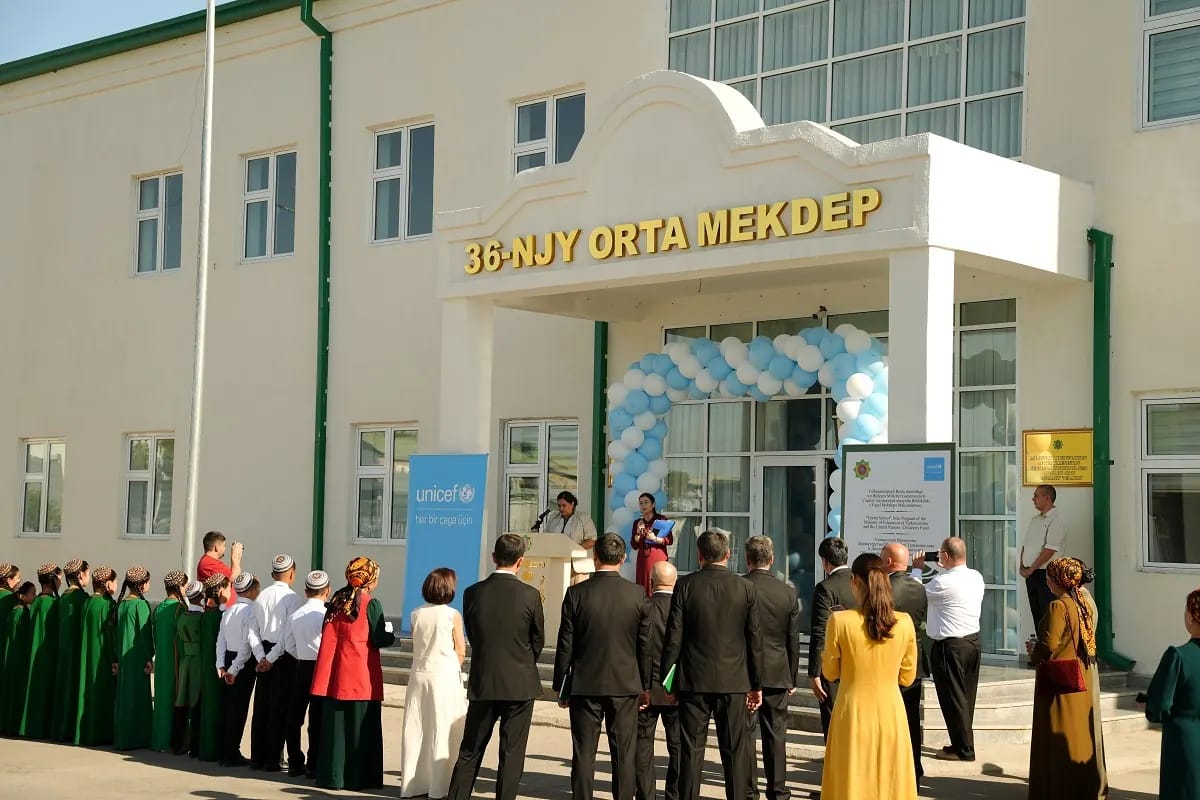
A modern solar power station has been commissioned at Secondary School No. 36 in the city of Mary to provide an opportunity to study renewable energy sources.
Ahead of the new academic year, an autonomous solar energy system was launched at Secondary School No. 36 in Mary. Built as part of a joint initiative of the Ministry of Education of Turkmenistan and the United Nations Children’s Fund (UNICEF), the facility will not only improve the school’s energy supply but also serve as a practical learning centre for students.
The new solar power station consists of a 12.5 kW photovoltaic system, a 48 kWh lithium battery and a hybrid inverter. The system makes it possible to provide lighting for the school grounds and sports field, as well as operate microclimate systems.
One of the key features of the project is its practical significance for the education system. The solar station is equipped with a digital monitoring system that displays energy generation, battery status and consumption levels in real time.
This capability will allow students to study data on energy production and consumption during physics lessons using a real operating energy system as an example. They will also be able to expand their practical knowledge of semiconductor physics, energy storage and environmentally friendly energy sources.
The proximity of Secondary School No. 36 in Mary to the State Energy Institute further increases the significance of the project. The educational facilities established at the school are intended to be used as a centre for practical training in renewable energy sources for schoolchildren and students from the region.
The project is one of the practical examples of implementing the goals of Turkmenistan’s National Strategy for the Development of Renewable Energy until 2030. Such initiatives contribute to increasing the younger generation’s knowledge of clean energy sources and modern technologies, while also supporting the training of future engineers and scientists.




Comments
No comments yet. Be the first.