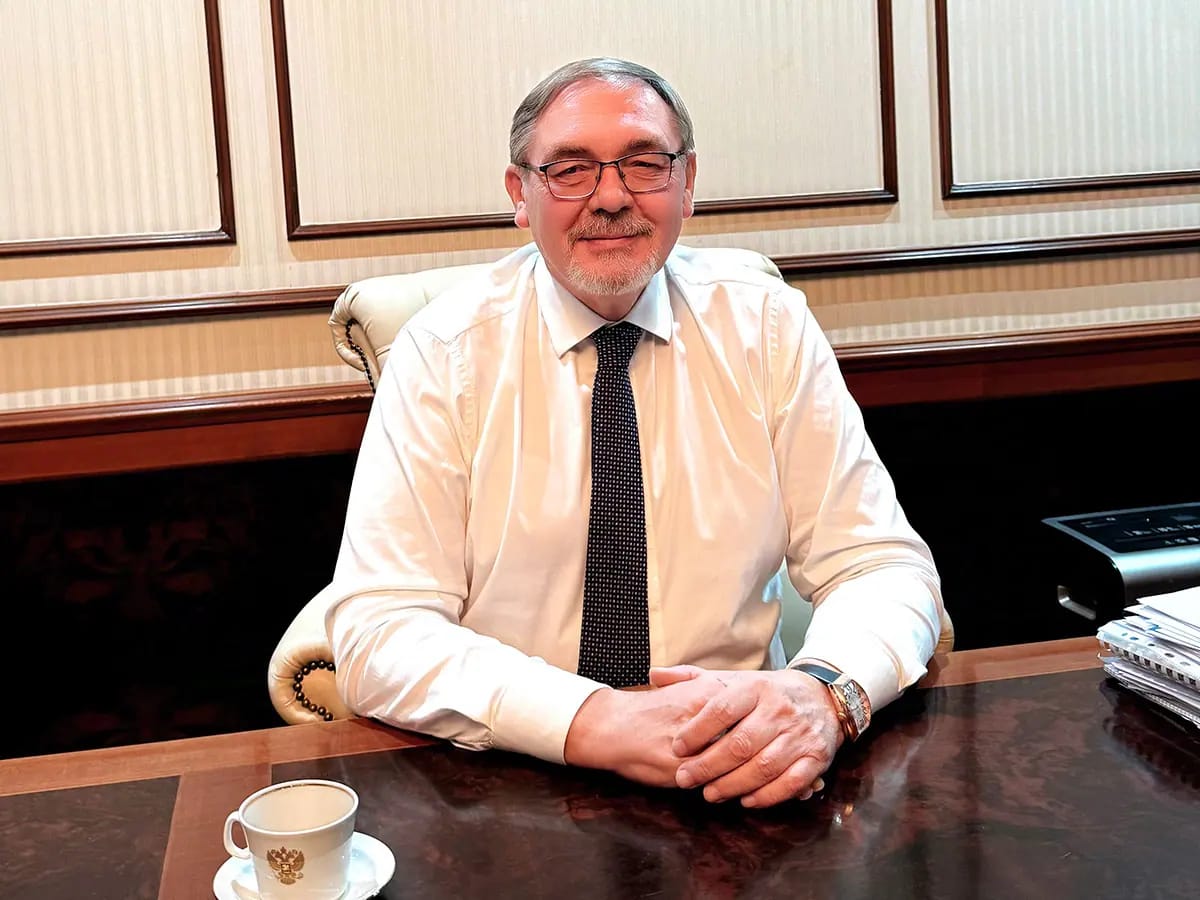
— Ivan Kirillovich, Russia celebrates Diplomatic Worker’s Day every year on February 10. What does this holiday mean to you personally and to the Ministry of Foreign Affairs as a whole?
— Thank you for the question. For me, this professional holiday primarily symbolizes the continuity of generations in diplomatic service. It is a convenient opportunity to communicate with mentors, congratulate subordinates, and exchange news with long-standing colleagues who currently work in Moscow or at foreign missions.
Although Diplomatic Worker’s Day appeared in our calendar relatively recently — the relevant decree was signed by President of Russia Vladimir Vladimirovich Putin in 2002 — Russian diplomacy has deep historical roots. Since the 9th century, Ancient Rus has acted as an active participant in international relations in Europe. A notable historical example is the mission sent to Constantinople in 838, when Rus was first represented as an independent state at the court of Byzantine Emperor Theophilos.
The chosen date is linked to the first documentary mention of the Ambassadorial Office (Posolsky Prikaz), the first centralized body responsible for foreign affairs, dated February 10, 1549.
— What qualities should a modern diplomat possess? Have the requirements for the profession changed in recent years?
— In my opinion, the fundamental principles of diplomacy remain unchanged. Professional competence, deep knowledge, responsibility, and the ability to conduct negotiations and find mutually acceptable solutions even in the most complex situations are key qualities of this profession. Naturally, specialists in international relations must have excellent command of foreign languages — this requirement has always remained relevant.
At the same time, the world is changing rapidly, the pace of life is accelerating, information pressure is increasing, new forms of communication are emerging, and new challenges arise — from cybersecurity to climate change. All this requires diplomats to have a broad outlook and the ability to quickly adapt to new conditions. Skills in using modern technologies and specialized software are becoming increasingly important.
Nevertheless, regardless of circumstances, the main duty remains the protection of national interests, respect for international law, and readiness for honest and equal dialogue. It is crucial to firmly defend one’s country’s positions while maintaining negotiation culture and a sense of proportion. At the same time, an appropriate sense of humor can also be helpful — sometimes a well-timed joke can ease tensions faster than lengthy discussions. I have witnessed this many times in my professional practice.
— How is the Ministry of Foreign Affairs of the Russian Federation adapting to new conditions? Are artificial intelligence technologies being introduced?
— For now, we rely on the capabilities of natural intelligence. Speaking seriously, our foreign policy institution is steadily evolving, and our staff continuously acquire new professional skills. Overall, we are keeping pace with the times.
Digital diplomacy tools have long been integrated into our daily work and are actively used to promote Russia’s approaches on the international agenda. The structure of the Ministry is also being adjusted to modern realities: in 2019, the Department of International Information Security was established; in 2022, the Department of Multilateral Humanitarian Cooperation and Cultural Relations was created; and in 2025, a separate department for cooperation with Africa began its work.
Existing departments are also being adapted: the Department of Pan-European Cooperation was renamed the Department of European Issues, while the Department of North America became the Department of the North Atlantic.
In addition, educational programs and professional development courses for future and current Russian diplomats are being continuously improved. They now cover relevant topics such as generative artificial intelligence, cybersecurity, big data processing, and others. Many of my colleagues, especially young specialists, are already actively applying this knowledge in practice.
— Russian diplomacy is often described as a serious school with rich traditions. What role do these traditions play today?
— I am convinced that the best qualities of Russian diplomats, past and present, have always been and will remain conscious patriotism, a high level of professional culture, and a deep understanding of the national interests of their Motherland. These are timeless values forming the foundation of our service.
As for Diplomatic Worker’s Day, over recent years Russia has developed its own ceremonial traditions. On February 10, a formal gathering is held in the high-rise building on Smolenskaya-Sennaya Square, where the Minister of Foreign Affairs of the Russian Federation, S. V. Lavrov, delivers a congratulatory address. On this day, distinguished employees are awarded departmental and state honors.
Flowers are laid at memorial plaques in the Ministry building bearing the names of colleagues who perished during the Great Patriotic War, died while performing their duties in peacetime, or became victims of repression.
In addition, ceremonial meetings, festive programs, and protocol events are held at all Russian foreign missions. I assure you that the Embassy of Russia in Ashgabat is no exception — we have many events planned for the coming week. Updates can be followed on our social media platforms.
— Ivan Kirillovich, one final question. You have been working in Turkmenistan for several years now. Could you share your impressions of our country?
— Indeed, I have been working in Ashgabat for more than two and a half years, and representing Russia’s interests on the hospitable Turkmen land is a great honor for me.
Turkmenistan has a rich cultural heritage and distinctive traditions. I enjoy traveling around your country. Recently, I visited Mary velayat for the first time and was in the city of Serhetabat, formerly known as Kushka.
Most importantly, I have met wonderful people here and felt the warmth and sincerity of the brotherly Turkmen people. My wife and I particularly value the friendly and cordial relations established among the members of the diplomatic corps accredited in Ashgabat.
Taking this opportunity, I would like to express my sincere gratitude to the President of Turkmenistan, His Excellency Serdar Berdimuhamedov, as well as to the National Leader of the Turkmen people, Chairman of the Halk Maslahaty of Turkmenistan, Gurbanguly Berdimuhamedov, for the excellent conditions created in the country for work and daily life.
I would also like to note that the professional holidays of the diplomatic services of Russia and Turkmenistan follow each other closely in the calendar — this has developed historically. In this regard, I am pleased to congratulate the Deputy Chairman of the Cabinet of Ministers of Turkmenistan, Minister of Foreign Affairs Rashid Meredov, as well as all colleagues of the Ministry of Foreign Affairs of Turkmenistan, on the upcoming professional holiday — Diplomatic Worker’s Day of Turkmenistan, celebrated on February 18. I wish them good health and further success.
I also wish the staff of the “Altyn Asyr” electronic newspaper continued success and prosperity. Thank you for the interview and our cooperation.
Comments
No comments yet. Be the first.