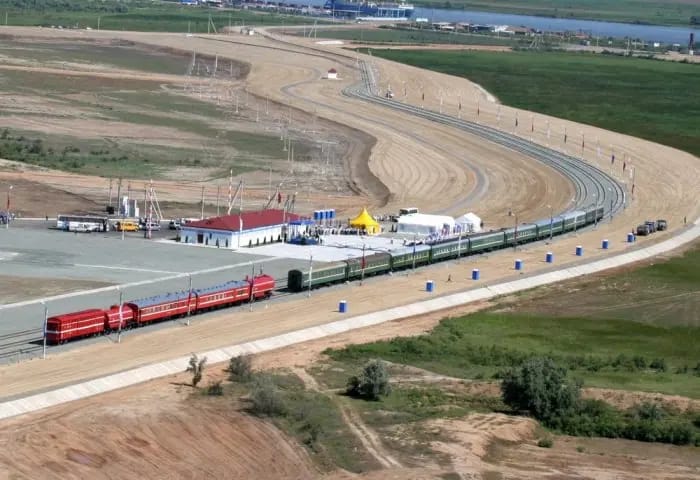
The development of the North–South and East–West international transport corridors holds strategic significance for Iran. President of the Islamic Republic of Iran Masoud Pezeshkian highlighted this during a meeting in Tehran on railway infrastructure, Trend agency reports.
Iran’s Minister of Roads and Urban Development Farzane Sadeg stated that domestic and foreign investments are being attracted to construct the corridors, modernize railways, and complete ongoing projects. The government aims to simplify document submission procedures and remove existing constraints to accelerate infrastructure projects.
The North–South international transport corridor was established in 2000 based on an agreement between Russia, Iran, and India. It consists of three routes: the eastern route via Turkmenistan and Central Asian countries, the middle route via the Caspian Sea to Russia, and the western route through the Caucasus and Eastern Europe.
On May 17, 2023, Russia and Iran signed an agreement to build the Rasht–Astara railway in northern Gilan province, approximately 163 km long with nine stations. The project will strengthen the North–South corridor and connect Iran’s railway network with the Caucasus, Russia, and Northern Europe. Russian investments are estimated at €1.6 billion, with a construction period of 48 months.



Comments
No comments yet. Be the first.