When Koytendag is mentioned, a corner of our country comes to life, astonishing everyone with its unique beauty and wonders. The high plateau with dinosaur footprints, which attracts travelers worldwide, fascinating mountain caves, gorges like Daraydere, Tutlydere, Umbardere, and Kyrkgyz, an underground lake inhabited by blind fish, the Unabi (Jujube) forest, and Ayrybaba peak—the highest point in our country—are all magnificent gifts of nature.
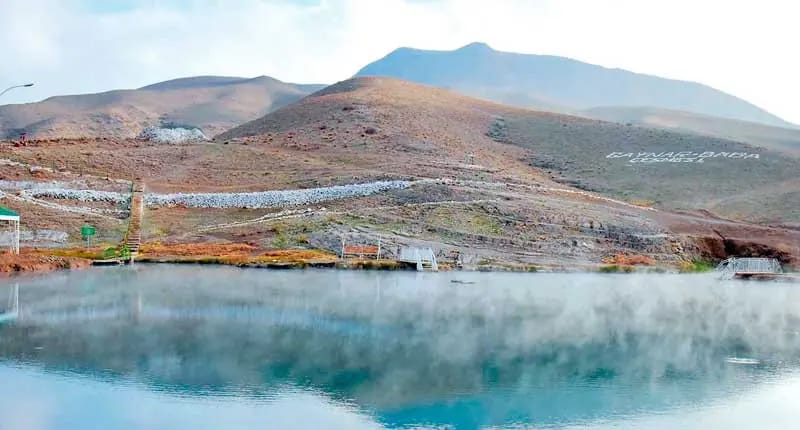
One of the wonders of Koytendag is "Hojagaynar," popularly known among the people as "Gaynarbaba," a unique spring located south of Garlyk town, originating from the western side of the mountain range. This spring, approximately 40 meters long and 30 meters wide, with a depth of about 3 meters in some places, is sometimes called a lake. The local population regards this unique spring as sacred because the merging of two different streams provides a remedy for various ailments. One stream is crystal clear, while the other is murky and whitish due to high hydrogen sulfide content. Locals call them "ak suv" (white water) and "gok suv" (blue/green water). The bubbling appearance of the water seeping from the mountain foot is the reason for the name "Gaynarbaba" (Boiling Father/Grandfather).
The National Leader of the Turkmen people, Hero Arkadag, writes in his book Turkmenistan – Heart of the Great Silk Road: "Its healing properties have been confirmed by scientific research. The water gushing from the ground is bubbling as if 'boiling,' which likely gave reason to call this place 'Gaynarbaba'." Renowned scientist Soltansha Atanyyazov noted that "Hoja" means "sacred" in this context, and "gaynar" refers to springs where the water bubbles up.
Modern scientific methods confirm the therapeutic characteristics of Gaynarbaba. The presence of hydrogen sulfide, minerals, and other chemical elements makes it suitable for treating skin and mental disorders, as well as digestive system ailments. A key feature is that the water remains at approximately 22°C in every season.
Another mysterious aspect is the presence of fish despite no connection to any river or waterway. Scientists of the Koytendag State Nature Reserve hypothesize that fish eggs attached to the bodies of migratory waterbirds might have started the fish population here. The fish swim fearlessly alongside people, a testament to their "domestication" because the spring is considered sacred and fishing is forbidden. There are no predatory fish here, but one can find mollusks, earthworms, and other invertebrates dating back to the Jurassic period. Therefore, scientists call this spring a "living museum of creatures." Additionally, an endemic mollusk called the "Garlyk dadrana," about 3-4 cm in size, lives here and is found nowhere else.






Comments
No comments yet. Be the first.