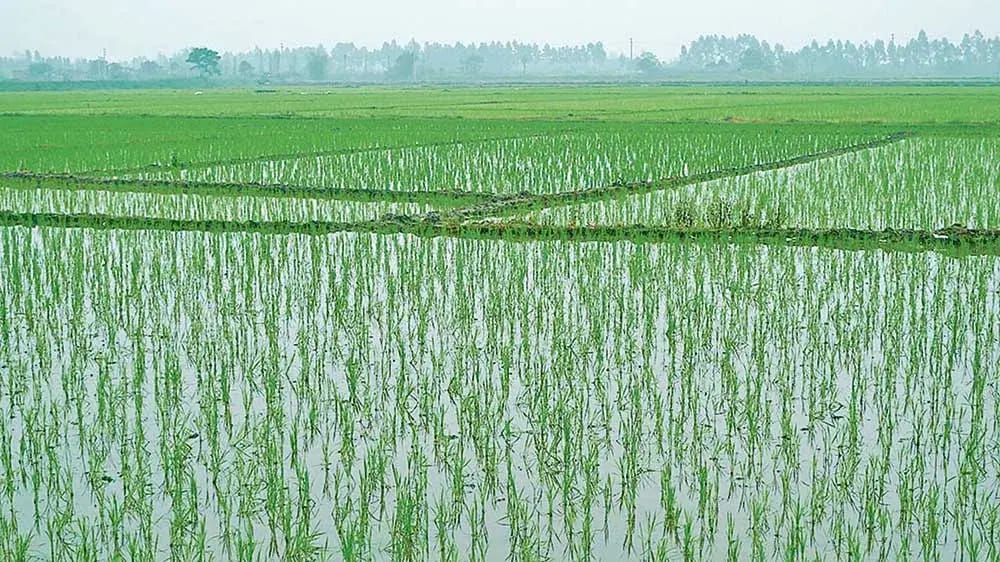
The rice crop, which plays an important role in ensuring food abundance in the agricultural fields of Turkmenistan, is sustainably cultivated mainly in the Lebap and Dashoguz velayats in accordance with specific soil and climatic conditions. Obtaining a bountiful harvest from this grain crop largely depends on the correct adherence to its planting, agrotechnical, and irrigation rules.
According to experts and experienced grain growers, one of the first and most responsible stages after planting rice consists of maintaining the moisturizing irrigation regime. After the seed is integrated with the soil, a moisturizing irrigation must be carried out 2-3 times without fail. This special irrigation practice should be repeated regularly every 3-4 days.
In accordance with the core requirements of agrotechnics, it is strictly forbidden to raise the water level in the plots (fields) until the planted rice seeds fully emerge above the ground. The reason is that if excess water accumulates in the plot during the initial days, sunlight cannot warm it up to a sufficient level. This, in turn, creates obstacles to the normal growth of the seeds and prevents the full and uniform germination of the rice. Therefore, strict adherence to the irrigation regime during the first days is of great importance in laying the foundation for sustainable productivity.





Comments
No comments yet. Be the first.